How to Improve Code Quality in Every Line You Write: Part 1.
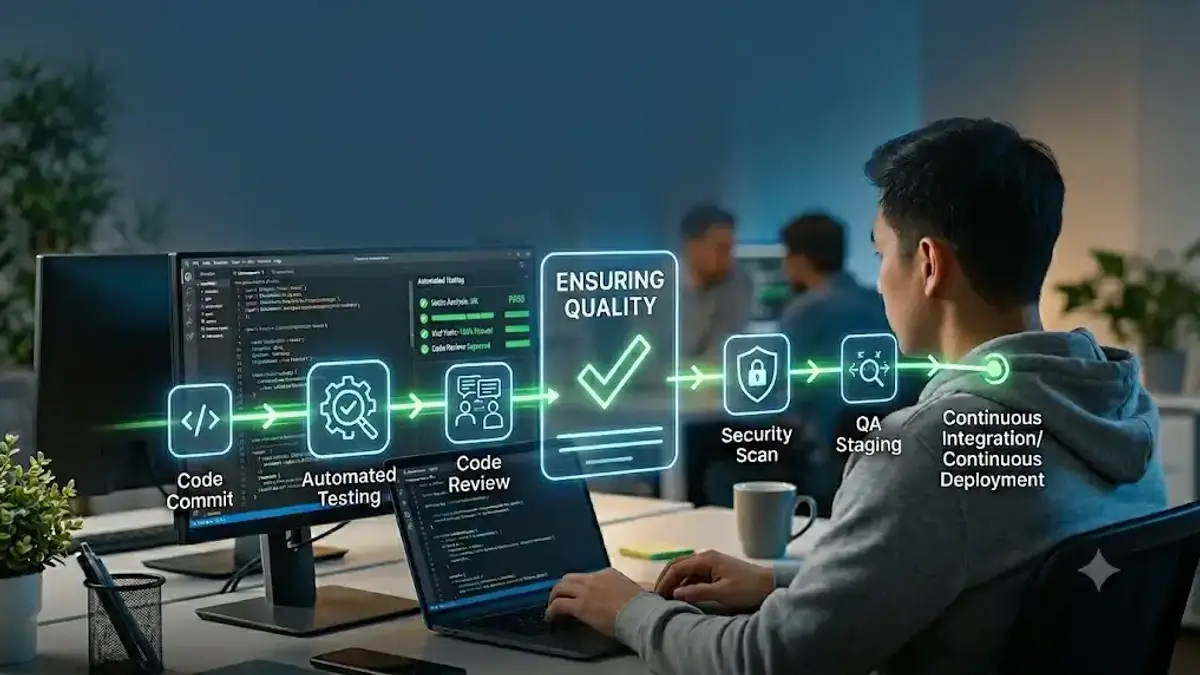
Code quality is a decisive factor for success. High-quality code goes beyond functionality—it’s the foundation for long-term maintainability, scalability, and user satisfaction. On the other hand, poorly written code leads to technical debt, recurring bugs, inflated development costs, and missed deadlines, all of which can hinder growth and innovation.
At CodeStringers, we recognize that every line of code we write shapes the value we deliver to our clients. That’s why we adopt a rigorous, structured approach to ensure the highest quality in all our projects. In this first part of our series, we’ll explore our philosophy and foundational principles that help us achieve exceptional code quality.
At CodeStringers, we believe that great software is built on the foundation of clean, efficient, and maintainable code. Our philosophy revolves around:
Precision: Every line of code is written with a purpose, minimizing redundancy and ensuring it aligns with project goals.
Readability: Code should not only execute correctly but also be easily understood by developers, enabling faster troubleshooting and seamless collaboration.
Sustainability: Writing quality code today ensures it remains functional and maintainable in the future.
Craftsmanship: We take pride in everything we build and believe software should be built with the same care and attention that one would put into a hand-made garment or piece of furniture.
We treat code quality as an ongoing commitment, not a one-time activity.
We emphasize collaboration at every level of our development process. Developers work closely with QA engineers, product managers, and DevOps teams to maintain transparency and alignment on quality goals.
This is fostered through:
Code Reviews: Every code change undergoes peer review to ensure it adheres to best practices.
Knowledge Sharing: We host regular workshops and retrospectives to learn from past projects and share new insights.
Mentorship: Senior developers mentor junior team members to elevate the collective skill level and promote consistency.
Agency: Everyone at the company is expected to speak up if they see a better way to do something than what was asked. We have a saying that goes something like, “I didn’t hire you to always agree with me.”
We embrace a culture of continuous learning and refinement. By analyzing metrics from previous projects and incorporating user feedback, we refine our workflows and adopt new tools or techniques to keep up with industry trends.
Readable code reduces the likelihood of errors and simplifies maintenance. At CodeStringers, we adhere to strict coding style guides such as the Google Style Guide, Airbnb Style Guide to ensure uniformity. We follow practices like:
Using meaningful and descriptive variable and function names.
Writing modular, reusable code for clarity and efficiency.
Adding comments judiciously to explain complex logic without over-documenting self-explanatory code.
As projects grow in complexity, scalability becomes critical. We design systems that can handle increasing workloads and new features without requiring a complete rewrite. Our architectural principles focus on:
Separation of concerns: Modular components that isolate functionality.
Dependency management: Reducing coupling and using well-tested libraries.
Cloud-readiness: Designing applications optimized for distributed environments like AWS or Azure.
Testing is integrated into our development lifecycle to catch issues early. Our strategy includes:
Unit Testing: Verifying the smallest components of the application for correctness.
Integration Testing: Ensuring different modules work together seamlessly.
Regression Testing: Re-testing after updates to ensure existing functionality is unaffected.
End-to-End Testing: Simulating user interactions to validate the entire workflow.
Well-documented code is as important as well-written code. Documentation ensures developers can quickly onboard a project and maintain it effectively. We prioritize:
API documentation.
Inline comments for complex algorithms or business logic.
System architecture diagrams to provide a high-level understanding of the application.
Quality isn’t a single milestone - it’s a continuous process. At CodeStringers, we’ve built a culture, adopted best practices, and embraced cutting-edge tools to ensure every line of code meets the highest standards. By focusing on readability, scalability, testing, and documentation, we lay a strong foundation for delivering reliable, maintainable software.
In the next part of this series, we’ll showcase how these principles translate into practical applications through examples, case studies, and lessons learned. Stay tuned to see how CodeStringers brings quality to life in every project.
In a no-risk discovery we look at how your work moves between your systems today and show what one connected system would do differently. You pay only if you proceed. Or see how we approach it.
More on the same problem:
ERP Migration Cost: The Line Items Nobody Budgets For (article)
Code Review Best Practices: 8 Habits That Actually Catch Bugs (article)
Zoom CRM Integration: The Native Extension, Flow, and When You Need Code (article)
Common measures include test coverage, defect rate after release, cyclomatic complexity, duplication and the time it takes to make a change safely. None of them is sufficient alone. A practical view combines a few automated metrics from static analysis with review feedback and the number of bugs that reach production. The trend over months matters more than any single number on a given day.
Performance is how fast and efficiently code runs. Quality is how easily it can be understood, tested and changed without introducing errors. The two can conflict, since heavily optimized code is sometimes harder to read. Most systems need quality first, because readable code can be optimized where measurement shows it matters, while unreadable fast code is hard to fix at all.
Poor quality raises the cost of every change after the first release, because each fix takes longer and risks breaking something else. That cost shows up as slower feature delivery, more time on bugs, and higher turnover when developers avoid the codebase. Investing in standards, reviews and tests during the build is cheaper than paying that interest for years afterwards.
Deadline pressure that skips reviews and tests, unclear requirements that lead to code written for a moving target, inconsistent standards across a team, and a lack of ownership once the original developers leave. Tools can catch style and some defects, but the root causes are process and culture, which is why the article leads with values before practices.
Ask for an independent code review from a senior engineer who did not write it, request the test coverage report and the results of a static analysis run, and ask how long a small change takes from request to production. Look at whether documentation exists and whether a new developer could set up the project in a day. Slow, risky changes are the clearest symptom.
"Something isn't working." "We're outgrowing our tools." "We're afraid to make the wrong move." No-Risk Discovery is a short, practical conversation that gets you clarity before you commit to anything big. We'll tell you if we're a fit. If we're not, we'll tell you that too.
Say who you are and ask. A person replies within one business day.