Decisions with downstream impact.
Every choice is weighed against the systems and teams that have to live with it next quarter, not just this one.
Most failed technology efforts don’t fail because the software was bad. They fail because decisions were made in isolation, each vendor optimized for their own piece, and no one owned the system as a whole.
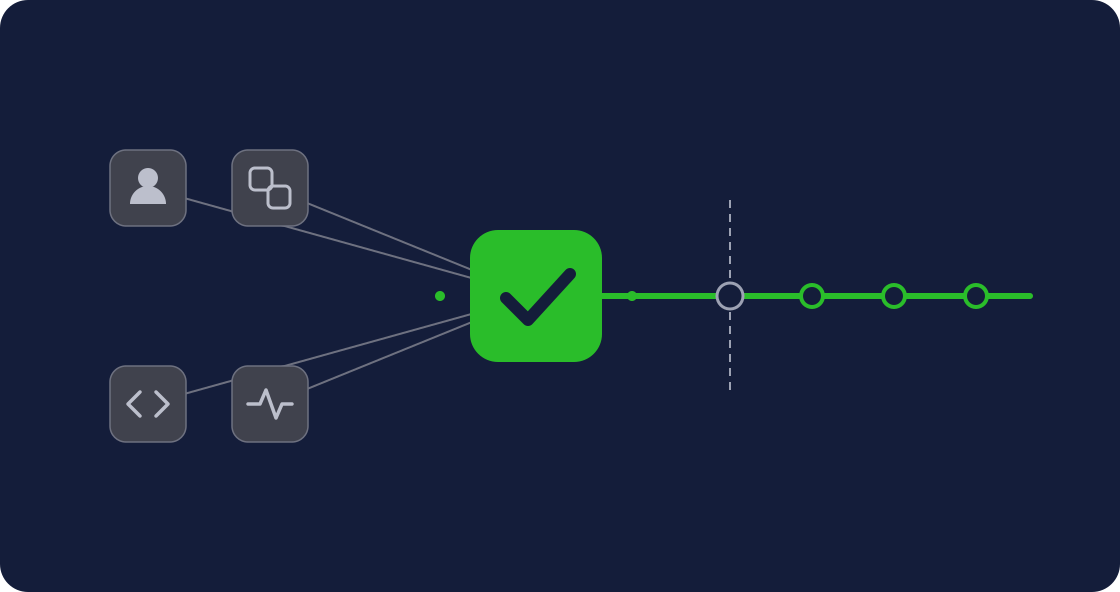
It rarely comes down to bad software. When something breaks, fingers point — but nothing gets fixed, because the work itself was structured to fail.
We mean decisions, workflows, and ownership — not just technical connections.
Every choice is weighed against the systems and teams that have to live with it next quarter, not just this one.
The way people actually do the work drives the design — not a vendor’s data model or a tidy diagram.
When two right answers conflict, someone accountable makes the call — instead of the tradeoff quietly drifting.
To guide decisions — senior ownership over technology, in the room from day one.
To make the tools you already run work together reliably.
Only when it’s truly necessary — never as a default.
Making sure the trains are on time, providing continuity for your business operations.
Business application platforms are the foundation. Our solutions are built user experience and workflow first, features second: a CRM is a CRM, and the platform you already run is the one we build on. Zoho is our partner; the rest we support through their published APIs, with the keys coming from your own instance in production. A platform we have not connected yet is a small project for the first customer who asks.


















Operationally complex isn’t about size — it’s about how many moving parts have to work together for nothing to break. If three or more of these ring true, keep reading.
Stays in one place across the engagement, instead of getting lost between vendors.
Stay with the people accountable for outcomes — not delegated away by default.
Get made deliberately, with their cost and reversibility visible up front.
Doesn’t disappear after launch — the same owner is still there when something needs changing.
When fragmentation has started to get expensive. If two or three of these sound familiar, the integrated model usually pays for itself quickly:
Whether this approach fits your business.
Why our way of working is different.
One operating model expressed across several systems, with one owner for how they fit together. It is not a set of applications exchanging records. It covers the decisions, where a quote becomes an order and which system is right when two disagree, the workflows people actually run, and clear ownership of tradeoffs. Four disciplines deliver it under one partner: fractional CxO leadership, business systems integration, custom software only where needed, and managed technical operations.
Because decisions are made in isolation, each vendor optimizes for its own piece, and no one owns the system as a whole. When something breaks, fingers point but nothing gets fixed, because the work was structured so that the seam between vendors belongs to nobody. The failure usually shows up after go-live, when real customers, data and exceptions meet the system at once.
It is about moving parts, not size. Signals include multiple systems running the business, processes that grew organically, spreadsheets that have become critical infrastructure, and a feeling that changing anything is risky. If two or three of those are true, fragmentation has started to cost money and the integrated model usually pays for itself quickly. Under about fifteen people, coordination cost tends to exceed the friction.
The visible cost is scoped in discovery and quoted as a fixed, guaranteed estimate, with discovery free unless the client proceeds. The cost it removes is the one separate vendors do not price: the reconciliation, re-keying and rework that happen in the seams between them, and the decisions that get made implicitly by whoever configured a screen that week. Retainer clients see the full cost of a release before committing.
No. The solution is built on the platforms the business already runs, with each one connected through its published APIs and the keys coming from the client's own instance. One partner means one owner for the decisions and the seams, not one vendor for every application. A platform that has not been connected before is a small project for the first client who asks.
We write your systems’ configuration as code and let AI apply it: fields, picklists, layouts, workflow rules, integrations, read back and verified after every step, so a build that took weeks of clicking takes days.
Because the work is programmatic, we quote the outcome, not the hours. The estimate is guaranteed and discovery is no-risk.
Our own CRM rebuild in October 2026: 21 shared picklists, 3 modules, 88 fields, 7 layouts, 23 workflow rules and 16 actions, built through code in 22 verified runs, every step read back.
The same tools that configure your systems today are what run our agentic solutions tomorrow: one surface over the systems you already own. See the agentic solutions
Start with a short, practical conversation about what’s actually worth doing first.