Inside Our Software Quality Assurance Process: Part 2.
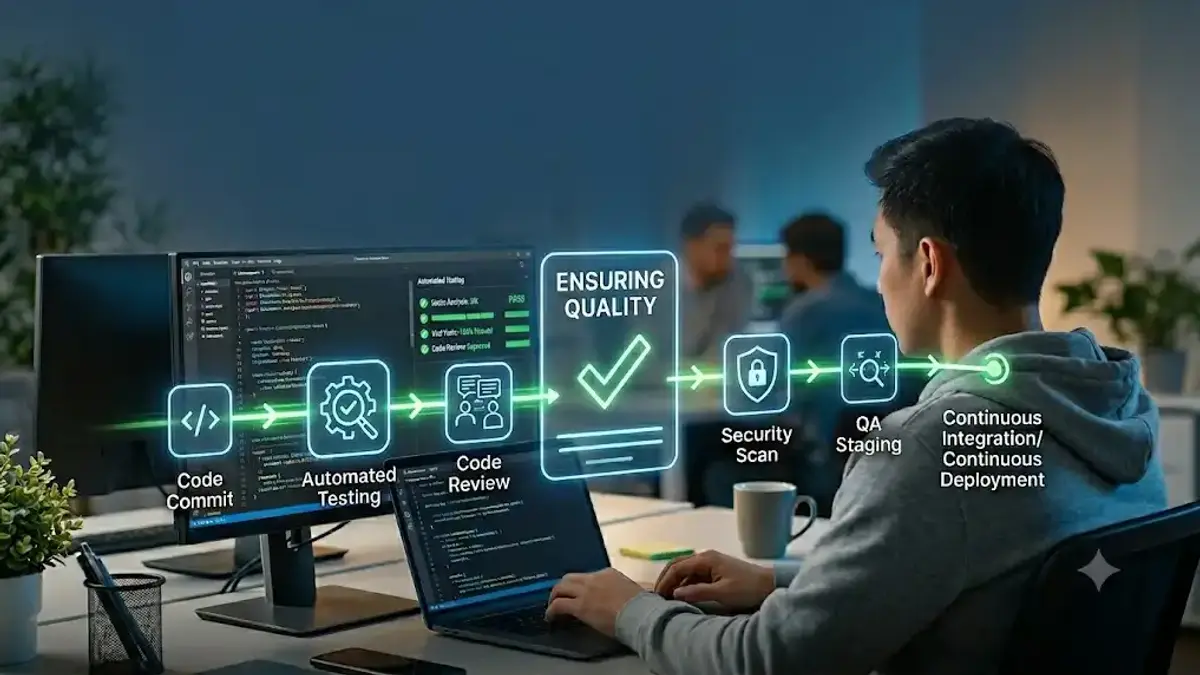
In the first part of this series, we discussed the philosophy, and foundations that form the backbone of CodeStringers’ approach to code quality. While principles and tools are essential, their true value is realized when applied to real-world projects. In this second part, we’ll dive into practical experiences, showcasing how our methodologies translate into tangible outcomes. From that, you’ll see how we ensure quality in every line of code while delivering exceptional value to our clients.
Code reviews are one of the most effective and impactful practices for ensuring code quality. At CodeStringers, we treat peer reviews as a mandatory step in our development process, and they play a crucial role in delivering robust, secure, and maintainable software.
Why Code Reviews Matter
Catch issues early
Promote collaboration
Maintain consistency
Foster accountability
We have a structured and systematic approach to code reviews to ensure they are efficient and effective. Here’s how we do it:
Adherence to Coding Standards
Every team member follows a coding style guide (e.g., Google Style Guide, Airbnb Style Guide) to ensure consistency in naming conventions, indentation, and formatting.
Tools like Prettier or ESLint are used to automate style enforcement before reviews.
Clarity and Readability
Reviewers ensure that code is easy to understand for future developers. They check for:
Meaningful variable and function names.
Appropriate comments to explain complex logic.
Avoidance of unnecessary complexity.
Potential Performance Optimizations
Reviewers analyze whether the code is optimized for performance. They consider:
Use of efficient algorithms and data structures.
Avoidance of redundant calculations or excessive memory usage.
Suitability of caching or asynchronous operations where applicable.
Security Considerations
Security is a top priority, especially for projects handling sensitive data. During reviews, we evaluate:
Proper validation and sanitization of user inputs.
Secure handling of credentials or API keys.
Protection against vulnerabilities like SQL injection, cross-site scripting (XSS), or buffer overflows.
Testing and Edge Cases
Reviewers ensure that the code includes adequate test coverage for all critical functionality and edge cases. This includes verifying:
Unit tests for small, isolated functions.
Integration tests for complex workflows.
Proper handling of invalid or unexpected inputs.
To streamline the review process and ensure consistency, we use detailed checklists for every review. These checklists act as a guide, ensuring reviewers focus on critical aspects without missing important details. A typical checklist might include:
Is the code free of obvious bugs or syntax errors?
Does it conform to coding standards and style guides?
Are functions and methods appropriately modular?
Are there sufficient comments and documentation?
Are there performance or scalability concerns?
Does the code adhere to security best practices?
Are all new features or changes covered by automated tests?
A good code review is not just about finding faults; it’s an opportunity for constructive feedback. Our reviewers:
Focus on the code, not the individual, fostering a positive and respectful environment.
Provide actionable suggestions rather than vague criticisms.
Highlight what the developer did well, reinforcing good practices.
Static analysis tools play a crucial role in maintaining code quality and efficiency at every stage of development. At CodeStringers, we leverage tools like SonarQube, ESLint, and others to streamline our development process and ensure every line of code adheres to the highest standards.
Static analysis tools examine the source code to detect issues such as:
Code smells (patterns in the code that may indicate deeper problems).
Inefficiencies in logic or resource use.
Security vulnerabilities.
Violations of coding standards or style guides.
These tools are "static" because they don't require the code to be executed, making them ideal for early-stage development.
Version control is a cornerstone of modern software development, enabling teams to manage code changes efficiently and collaboratively.
Here’s a detailed explanation of the practices we follow:
Branching models define how developers create, manage, and merge code branches within the version control system. We use well-defined models to keep our codebase organized and reduce conflicts.
GitFlow: A branching strategy that separates feature development, releases, and hotfixes into distinct branches.
Trunk-Based Development: A simpler strategy where all developers work on a single main branch (or "trunk") and create short-lived feature branches.
Commit messages are not just logs - they’re a vital part of the development workflow. Well-written commit messages make it easier to understand the history of changes and troubleshoot issues.
Why It Matters:
Makes the history of changes understandable for the entire team.
Helps with debugging and tracking down the root cause of issues.
Ensures alignment with project management tools (e.g., referencing task IDs).
Pull requests (PRs) are an essential part of our collaborative workflow. They serve as a gateway to review, discuss, and approve code changes before merging them into the main branch.
How Our Pull Request Workflow Works:
Create a Pull Request
Conduct Thorough Reviews
Provide Feedback
Approval and Merging
Close the Branch
We also apply many other methods to ensure code quality suitable for each project, especially automated testing and CI/CD pipelines. This is a big topic so we will write about it in other articles.
Our software development lifecycle is grounded in Agile principles. Daily stand-ups ensure team alignment and help identify potential quality risks early. By breaking projects into manageable sprints, we focus on iterative improvement and integrate continuous testing throughout the process.
This iterative approach allows us to adapt quickly to changes while maintaining high standards of quality.
Our teams collaborate closely, fostering a culture of open communication and accountability. QA engineers work alongside developers from the very beginning, ensuring that quality considerations are baked into every stage of development.
Frequent and open communication between team members ensures alignment and helps address potential issues before they escalate. Clear documentation plays a critical role in bridging gaps between developers and other stakeholders.
Quality is not just the responsibility of QA teams. By fostering a culture where every team member takes ownership of quality, we create a stronger, more resilient software development process.
At CodeStringers, we don’t just aim to write functional code—we strive to write code that lasts, scales, and delivers exceptional value to our clients. By combining philosophy, best practices, and hands-on expertise, we ensure that quality is embedded in every line of code.
These principles and practices aren’t just theories; they’ve been proven time and time again in our real-world projects. Whether it’s reducing technical debt, optimizing performance, or ensuring compliance with strict standards, we consistently deliver results that exceed expectations.
As you embark on your journey to improve code quality in your organization, remember that quality is not an endpoint—it’s a mindset. Together, we can build better software, one line of code at a time.
In a no-risk discovery we look at your CRM, finance and operations systems and who owns each part, and show what a connected system would do differently. You pay only if you proceed. Or see how we approach it.
More on the same problem:
The Custom Software Development Process, Explained (Without the Jargon) (article)
How We Work With New Clients: Inside Our Client Discovery Process (article)
Nobody Wrote The Process Down (video)
Requirements review, so that acceptance criteria are testable before work starts; test planning, which decides what is automated and what is manual; development-time checks such as linting, static analysis and peer review; functional and regression testing in a staging environment; and release verification with monitoring in production. Each stage catches a different class of defect, and skipping one shifts cost to the next.
Testing is the act of checking that software behaves as intended. Quality assurance is the wider set of practices that prevent defects from being introduced, including standards, reviews, tooling and process. Testing finds problems; QA reduces how many there are to find. A team with strong testing but weak QA keeps catching the same kinds of bugs release after release.
Reviews work best in small batches that take under an hour to read. Changes over a few hundred lines get skimmed rather than reviewed, so the fix is smaller pull requests, not longer reviews. Teams usually aim to return a review within one business day so that work does not queue up. Checklists keep reviews consistent without making them slower.
Start with the linter and formatter standard for your language, then add a security scanner that checks dependencies and common vulnerability patterns. Run them in the continuous integration pipeline so results are automatic and visible on every change. Tool choice matters less than making the checks mandatory and keeping the rule set tuned so developers do not learn to ignore warnings.
Track defects found in production versus before release, the time from a bug report to a fix, and how often releases are rolled back. A rising share of bugs caught before release and a falling rollback rate indicate the process is working. Review these in retrospectives and adjust the process rather than adding more testing by default.
"Something isn't working." "We're outgrowing our tools." "We're afraid to make the wrong move." No-Risk Discovery is a short, practical conversation that gets you clarity before you commit to anything big. We'll tell you if we're a fit. If we're not, we'll tell you that too.
Say who you are and ask. A person replies within one business day.