Duplicate Financial Entry.
Sales, operations, purchasing, and finance enter the same customer, order, invoice, bill, or payment information in multiple systems.
CodeStringers implements and integrates Zoho Books as part of broader digital enablement solutions built around your revenue, purchasing, payment, reconciliation, and reporting workflows. We connect Books to CRM, Inventory, ecommerce, payroll, banking, payment platforms, analytics, third-party systems, and custom software so financial data moves with the business instead of living in a separate accounting silo.
 Zoho AuthorizedConsulting Partner
 Zoho and the Zoho logo are registered trademarks of Zoho Corporation.
A technically correct accounting setup can still fail the business if sales, purchasing, fulfillment, billing, collections, payments, banking, and reporting do not move together. Finance may close the books correctly while teams still re-enter transactions, reconcile systems by hand, wait for operational data, or discover exceptions only after the month has ended.
The result is familiar: duplicate entry, delayed invoicing, mismatched order and financial data, slow reconciliation, weak cash visibility, manual approvals, inconsistent customer or vendor balances, and management reports that arrive too late to guide the business.
The problem usually is not whether Zoho Books can perform the accounting. It is whether the complete financial workflow was designed as part of the operating system around it.
Sales, operations, purchasing, and finance enter the same customer, order, invoice, bill, or payment information in multiple systems.
Deals, orders, fulfillment, invoices, payments, credits, and collections depend on manual updates between teams and applications.
Banking, payments, expenses, and operational transactions require recurring cleanup before finance can trust the numbers.
Purchase orders, receipts, vendor bills, approvals, and payments are not connected tightly enough to prevent errors and delays.
Leadership sees accounting results without enough operational context to understand cash, margin, working capital, and business performance.
The strongest financial systems are designed around the people and workflows that create the transactions — not around the accounting menu. We map how operational activity becomes financial truth, where controls belong, and what each persona needs to complete the work accurately and efficiently.
Finance, accounting, sales, purchasing, operations, managers, employees, customers, vendors, and external accountants.
How quotes, orders, fulfillment, invoices, bills, payments, expenses, credits, and refunds move through the business.
Approvals, credit rules, purchasing controls, tax treatment, payment timing, exceptions, close requirements, and financial ownership.
Chart of accounts, customers, vendors, items, transactions, banking, automation, integrations, permissions, and reporting.
Faster invoicing and collections, fewer manual entries, cleaner closes, stronger controls, better cash visibility, and more trusted reporting.
Zoho Books is the platform. Connected financial operations are the goal.
Application expertise still matters. We configure Zoho Books deeply so the accounting platform reflects your business model, supports appropriate financial controls, and connects cleanly to the operational systems that create the transactions.
Design account structure, journals, opening balances, fiscal settings, dimensions, and accounting controls that support reliable reporting.
Configure estimates or quotes, invoices, recurring transactions, credits, payment terms, customer balances, reminders, and collection workflows.
Configure vendors, purchase orders, bills, vendor credits, approvals, payment workflows, and matching processes around how purchasing actually works.
Connect bank and credit-card feeds, define bank rules, matching practices, reconciliation workflows, and controls for reliable cash records.
Structure employee and business expenses, receipt capture, categorization, recurring expenses, reimbursements, and connections to expense workflows.
Configure sales-tax treatment, exemptions, tax reporting, vendor tax information, 1099 workflows, and related controls where applicable.
Configure projects, budgets, time tracking, approvals, billable expenses, and project invoicing for service or project-based businesses.
Use workflow rules, approvals, notifications, custom fields, webhooks, functions, and Zoho Flow to reduce repetitive finance work.
Configure currencies, exchange-rate handling, customer and vendor preferences, and transaction processes for businesses working across markets.
Build reports, customer and vendor experiences, user permissions, accountant access, close procedures, and operating controls for long-term trust.
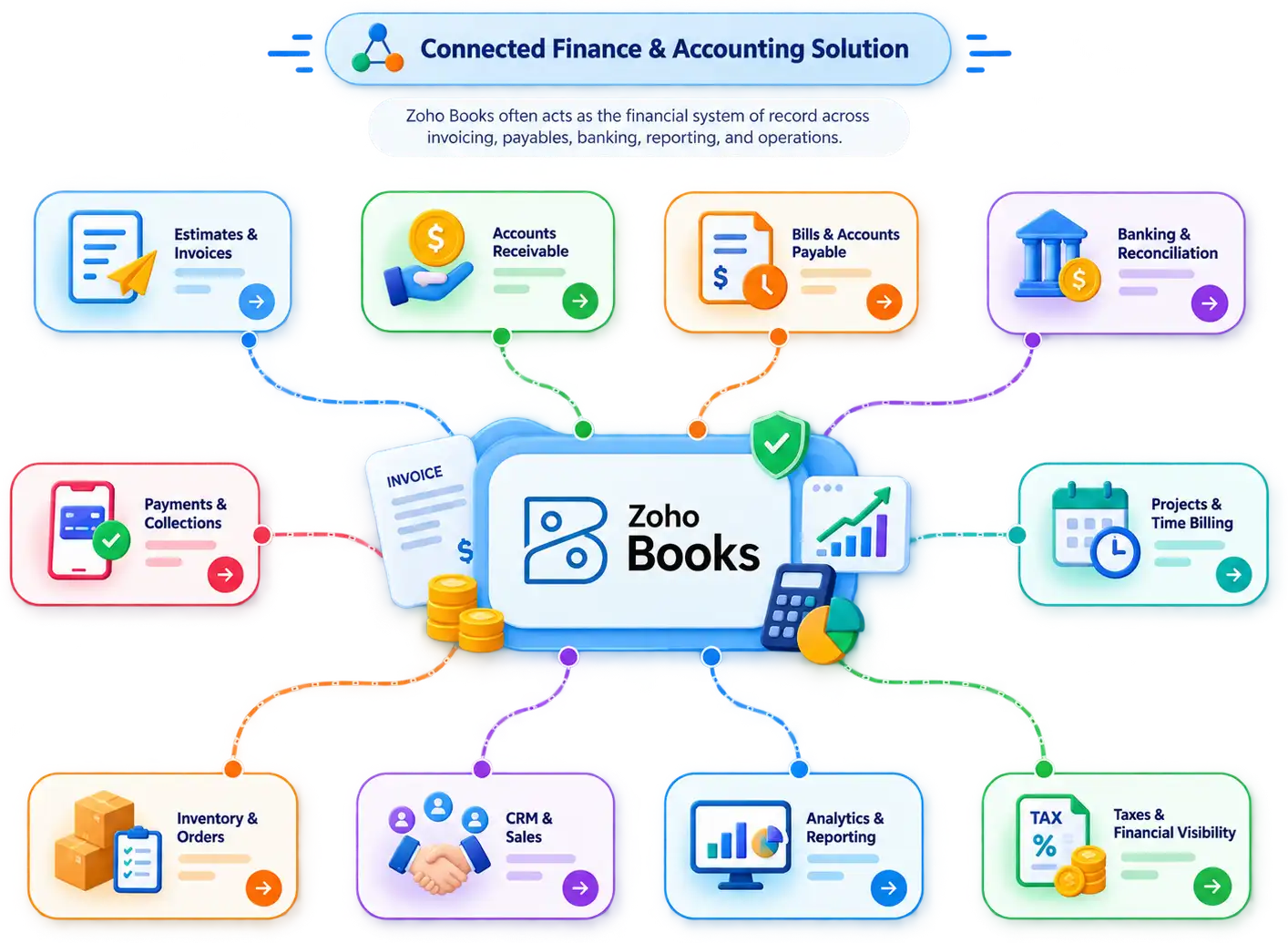
Zoho Books can become the financial system of record for customers, vendors, invoices, bills, payments, banking, taxes, and the general ledger. But almost every meaningful financial transaction starts somewhere else in the business.
A customer may originate in CRM, accept a proposal through Sign, place an order in Commerce, trigger inventory or fulfillment activity, receive an invoice from Books, pay through a payment platform, and ultimately appear in cross-system margin and cash reporting in Analytics. A vendor purchase may begin with replenishment or an operational need, move through approval and receiving, become a bill, and then flow through payment and reconciliation.
We design those complete journeys first, then connect Books to the applications and systems that create, approve, fulfill, settle, and report the transaction.
Accounting may end in Books, but financial truth depends on connected workflows across the business.
To the customer and employee, this should feel like one commercial journey — even when the transaction crosses sales, contracts, operations, accounting, payments, and reporting.
CRM manages the customer, opportunity, pricing context, and commercial decision; Sign or another agreement workflow captures approval when required.
The accepted commercial transaction becomes an order in Inventory, Commerce, a portal, or another operational system without re-keying the customer and product data.
Inventory, warehouse, project, service, or external operational systems complete the work and provide the status needed to trigger the correct financial event.
Zoho Books creates the appropriate invoice, applies payment terms and taxes, sends the transaction to the customer, and records payment through the configured payment workflow.
Bank feeds and payment transactions are matched, exceptions are resolved, and finance completes reconciliation and period-close controls using trusted transaction data.
Zoho Analytics combines CRM, operational, and Books data so leadership can see realized revenue, margin, collections, cash, and customer economics — not just booked sales.
The customer sees one purchase. Your team should see one connected financial workflow — not a trail of disconnected transactions.
We do more than configure the application. We connect, extend, and operate the broader customer-service solution your business depends on.
Deep Zoho Books setup aligned to your accounting structure, transaction flows, controls, banking, tax, reporting, and user responsibilities.
Connect Books to CRM, Inventory, ecommerce, payroll, expenses, banking, payment platforms, analytics, industry systems, and other applications.
Use Zoho Flow, Deluge, APIs, Creator, middleware, portals, and custom software where packaged financial workflows stop.
Support users, monitor integrations, maintain workflows, resolve exceptions, improve reporting, and evolve the production environment after go-live.
Design end-to-end business solutions where financial events are created naturally by the operating workflows that generate them.
Zoho Books provides a strong accounting and financial-management foundation. The complete solution may also require other Zoho applications, banking and payment platforms, payroll or tax services, external operating systems, and purpose-built software.
Books | CRM | Inventory | Analytics | Expense | Payroll | Sign | Flow | Creator | Commerce | Other Zoho Applications.
Banks | Payment Processors | Payroll Systems | Tax Services | Ecommerce Platforms | ERP Systems | Procurement Tools | Other Industry Applications.
Customer Or Vendor Portals | Approval Experiences | APIs | Middleware | Transaction Services | Specialized Billing Logic | Other Business-Specific Financial Workflows.
A connected environment where operational events become accurate financial transactions and financial insight feeds better business decisions.
Financial workflows change substantially by business model. We combine accounting-system expertise with knowledge of the operational journeys, revenue models, cost structures, controls, data, and integrations that matter in complex industries.
Marketing run as one governed system, from theme to lead.
Raise the ERP campaign to 55 a day; the leads are converting.
Budget proposal posted with the cap check. Your 1 applies it and I read it back.
From purchase order to margin by channel, one plant floor in chat.
Listings, deals with two sides, letters of intent and splits, from one message.
Referral to billing packet with identities masked by rule.
Tickets answered from knowledge, articles written as you solve, renewals seen early.
The operating model first, then one connected system on the platforms you already run.
The common denominator isn’t industries. It’s operational complexity.
End-to-end services that ensure Zoho Books is designed, implemented, migrated, integrated, extended, and optimized as part of the broader operating environment.
Map users, transaction journeys, accounting requirements, controls, source systems, integrations, approvals, reporting needs, and desired business outcomes.
Configure chart of accounts, customers, vendors, transactions, banking, tax settings, permissions, workflows, templates, portals, and reporting.
Connect Books with CRM, Inventory, ecommerce, payroll, expenses, banking, payment systems, external applications, APIs, and data services.
Plan, map, clean, migrate, reconcile, and validate financial master data, opening balances, customers, vendors, open transactions, and appropriate history.
Connect commercial and fulfillment events to invoicing, payments, reminders, credits, customer balances, collections, and reporting.
Connect purchasing, receiving, approvals, vendor bills, credits, payments, reconciliation, and vendor communication.
Build accounting reports and connect Books with Analytics to combine financial and operational data for cash, margin, working-capital, and management reporting.
Support users, monitor integrations, maintain financial workflows, improve controls, resolve issues, refine reporting, and evolve the solution over time.
We help determine whether Zoho Books is the right financial platform — and where QuickBooks, NetSuite, a specialized ERP, industry accounting software, or another financial system should remain part of the architecture.
Not sure? We will evaluate the accounting model, transaction flows, integrations, controls, and existing systems first — and recommend the right role for Zoho Books, even if migration is not the best answer.
Zoho Books is a strong fit for many small and mid-sized organizations that need full-featured accounting, banking, receivables, payables, automation, project billing, multi-currency support, portals, and reporting — particularly when the accounting system needs to connect closely with the broader Zoho ecosystem. The right answer depends on your accounting complexity, industry requirements, integrations, transaction volume, reporting needs, and existing financial stack.
Our services can include financial workflow and solution design, Zoho Books implementation, chart-of-accounts configuration, data migration, banking and reconciliation setup, receivables and payables design, tax configuration, workflow automation, CRM and Inventory integration, payment and payroll integration, reporting, custom development, user training, administration, and ongoing optimization.
For many small and mid-sized businesses, yes. Zoho Books provides broad accounting functionality and becomes especially compelling when CRM, inventory, expense, analytics, and other business workflows are already centered on Zoho. We evaluate the features, integrations, accountant requirements, historical-data needs, and business processes you rely on before recommending a migration.
It depends on the quality of the current data, chart-of-accounts complexity, transaction history, open receivables and payables, bank reconciliations, tax settings, inventory relationships, and connected applications. We plan the migration, clean and map the data, validate balances and open transactions, and define a controlled cutover rather than simply importing everything and hoping it reconciles.
CRM can manage prospects, customers, opportunities, quotes, and commercial relationships; Inventory can manage items, stock, purchasing, orders, and fulfillment; Books can manage the financial transactions and accounting impact. We design the ownership, events, synchronization, and exception handling among them so the employee experiences one process instead of three separate applications.
Yes. Zoho Books supports bank and credit-card feeds, transaction matching, bank rules, and reconciliation workflows. We configure the banking structure and operating procedures around how your finance team actually closes and controls the books, while accounting for the availability and behavior of your specific financial institutions and feed providers.
Yes. Zoho Books supports vendors, purchase orders, bills, vendor credits, purchase approvals, payments, and related payables workflows. For product-based businesses, we also design how those financial transactions should connect with Inventory receiving, replenishment, and operational purchasing processes.
Yes. Zoho Books includes project and time-tracking capabilities that can support budgets, timesheets, billable time and expenses, approvals, and project invoicing. We evaluate whether those capabilities are sufficient for the operating model or whether Zoho Projects, People, a vertical platform, or custom functionality should participate in the solution.
Yes. Depending on the systems involved, we can use native integrations, Zoho Flow, APIs, webhooks, middleware, or custom software. We focus on the complete transaction journey — including ownership, timing, errors, retries, reconciliation, and reporting — rather than treating the connector itself as the solution.
Yes. We can extend the broader financial solution using Zoho Creator, Deluge, APIs, Flow, middleware, portals, custom applications, and purpose-built services. This is useful when the business needs specialized approvals, billing logic, customer or vendor experiences, industry-specific workflows, or integrations that do not belong inside the accounting application itself.
Yes. We can assess configuration, chart of accounts, transaction workflows, customer and vendor data, banking, reconciliation, integrations, automation, permissions, tax settings, reporting, and operating procedures. We then redesign the areas that are creating manual work, unreliable balances, poor adoption, or disconnected downstream processes.
Yes. We provide ongoing administration, integration monitoring, workflow improvements, reporting changes, user support, troubleshooting, release management, documentation, and continuous optimization so the financial environment evolves with the business.
A typical consultant may focus primarily on configuring the accounting application. CodeStringers combines Zoho expertise with systems integration, custom software development, data architecture, workflow design, and ongoing technical operations. We treat Books as the financial system of record inside a larger digital enablement solution built around users, journeys, controls, and business outcomes.
A migration moves the chart of accounts, customers, vendors, items, open invoices and bills, and opening balances as of a cut-over date, usually a fiscal period end. Closed history is either imported as summary journals or kept in the old system for reference. Bank feeds are reconnected and reconciled from the cut-over date forward. The new system runs in parallel for one close so the balances can be compared before the old one is retired.
Zoho Books and Zoho Inventory share one organization, so items, stock, sales orders, purchase orders and bills are the same records in both. Zoho CRM connects through the native integration: customers, quotes and sales orders created in CRM become the customer and transaction records in Books, and invoice and payment status shows on the CRM account. The implementation defines which application creates each record so nothing is entered twice.
Yes. Zoho Books applies sales tax by rate and jurisdiction, records customer exemptions, and produces sales tax liability reports. For businesses selling into many states, a tax-rate service can be connected to keep rates current. Vendors can be flagged for 1099 tracking so payments accumulate through the year and the forms are prepared at year end. The configuration starts from what the accountant already files, not from the software's default settings.
Bank and credit card feeds bring transactions into Zoho Books. Bank rules categorize recurring items automatically, and the matching screen pairs each feed line with an invoice payment, bill payment, expense or transfer already recorded. Anything unmatched is either recorded from the feed or flagged as an exception. Reconciling weekly keeps the exception list short, and a monthly reconciliation confirms that the book balance agrees with the bank statement.
Yes. Zoho Books has an accountant role that gives an external accountant a login of their own, with permissions limited to what the business allows. The accountant can review journals, post adjustments, run reports and, where permitted, lock closed periods. Period locking matters: once a period is locked, transactions in it cannot be changed without unlocking, which protects the filed numbers. Sharing one login with the accountant defeats the audit trail and is best avoided.
Approvals can be required on estimates, sales orders, invoices, purchase orders, bills and expenses. A transaction waits in a pending state until an approver with the right role accepts it, and multi-level approval can route high values to a second approver. Workflow rules add conditions, such as approving only bills above a threshold or purchase orders from new vendors. Approvals belong where a control is actually needed; putting them everywhere slows the team without adding control.
We write your systems’ configuration as code and let AI apply it: fields, picklists, layouts, workflow rules, integrations, read back and verified after every step, so a build that took weeks of clicking takes days.
Because the work is programmatic, we quote the outcome, not the hours. The estimate is guaranteed and discovery is no-risk.
Our own Zoho CRM rebuild in October 2026: 21 shared picklists, 3 modules, 88 fields, 7 layouts, 23 workflow rules and 16 actions, built in the sandbox through code in 22 verified runs, every step read back.
The same tools that configure your systems today are what run our agentic solutions tomorrow: one surface over the systems you already own. See the agentic solutions
We will start with the people, transaction journeys, controls, integrations, and financial data your business depends on, then show you where Zoho Books fits and what the complete solution needs to turn operating activity into accurate, timely financial information.