INTEGRATED BUSINESS SOLUTION FOR BEHAVIORAL HEALTHCARE

Behavioral Health Software Built Around Coordination and Follow-Through.

Behavioral healthcare organizations rely on an EHR for clinical care, but they often depend on spreadsheets, email, and disconnected tools for the rest. CodeStringers builds platform-agnostic operational systems that connect your intake, referrals, scheduling, communication, reporting, and administrative workflows - without trying to replace the clinical EHR.

  • Works with your EHR
  • Improves coordination
  • Better operational visibility
  • Scalable for growth
Behavioral Healthcare OS: the AI control plane we build, over the platforms it runs on and delivering through the channels to behavioral healthcare providers.Three layers, read bottom to top: the platforms it runs over (Intake CRM, Intake desk, Clinical EHR, Billing, Scheduling, Analytics); the control plane, Behavioral Healthcare OS, with its capabilities (Intake, Authorization, Scheduling, Care team handoff, Follow-up, Human gates); and the channels it delivers through (SMS, Email, Phone, Company chat, E-consent), reaching behavioral healthcare providers.RUNS OVER THE PLATFORMS YOU ALREADY HAVEIntake CRMIntake deskClinical EHRBillingSchedulingAnalyticsWHAT WE BUILD: THE AI CONTROL PLANEBehavioral Healthcare OSIntakeAuthorizationSchedulingCare team handoffFollow-upHuman gatesDELIVERS THROUGHSMSEmailPhoneCompany chatE-consentBehavioral healthcare providers Behavioral Healthcare OS: the AI control plane we build, over the platforms it runs on and delivering through the channels to behavioral healthcare providers.Three layers, read bottom to top: the platforms it runs over (Intake CRM, Intake desk, Clinical EHR, Billing, Scheduling, Analytics); the control plane, Behavioral Healthcare OS, with its capabilities (Intake, Authorization, Scheduling, Care team handoff, Follow-up, Human gates); and the channels it delivers through (SMS, Email, Phone, Company chat, E-consent), reaching behavioral healthcare providers.RUNS OVER THE PLATFORMS YOU ALREADY HAVEIntake CRMIntake deskClinical EHRBillingSchedulingAnalyticsWHAT WE BUILD: THE AI CONTROL PLANEBehavioral Healthcare OSIntakeAuthorizationSchedulingCare team handoffFollow-upHuman gatesDELIVERS THROUGHSMSEmailPhoneCompany chatE-consentBehavioral healthcare providers
AI-driven integrated business solutions

The AI control plane.

Behavioral Healthcare Operations OS is an AI control plane around the clinical record and never inside it. It reads referrals for their operational fields, watches eligibility and authorizations, proposes scheduling, moves intake to billing stage by stage, and refuses to act on a record without consent on file. Identity is masked in every channel.

Company chat #intake-ops
#intake-opsCompany chat
  1. Elena M

    New referral from Valley Clinic for the IOP program.

  2. CodeStringers AI Solution Controller

    Intake I-⁠2291 created, payer on file, two items missing; request sent to the referrer by template; eligibility check queued.

  3. Elena M

    Authorization A-⁠118 for I-⁠2210 expires in nine days.

  4. CodeStringers AI Solution Controller

    Re-request drafted. Send?

    1 Yes, do it2 No3 Change something
  5. Elena M

    Schedule I-⁠2291's first session.

  6. CodeStringers AI Solution Controller

    No consent on file for I-⁠2291. Not scheduling until it is; consent request sent.

CRM intake, authorization and the run logOur skin
Intake I-⁠2291CRM
created 09:14
Referrer
R-⁠41, community clinic
Program
IOP
Payer
P-⁠03
Identity
visible to intake roles only
Status
Created Awaiting items
Referrer request
not sent sent by T-⁠07
Eligibility
not queued queued

Masking is a rule the plane enforces. The identity stays in the CRM and never reaches the chat. The coordinator works from the intake number.

Authorization A-⁠118CRM
intake I-⁠2210, payer P-⁠03
Expires
27 Sep, in 9 days
Visits used
8 of 12
Re-request
drafted from the payer's form, nothing clinical attached
Status
Re-request drafted Re-request pending
Submission
none submitted 09:21, approved by coordinator

Caught in week one. The denial that used to arrive in week six left as a re-request in week one, on one keystroke.

Run logControl plane
newest row on top
11:06
I-⁠2291 schedule REFUSED, rule: consent on file before scheduling
11:06
consent request re-sent to R-⁠41 by T-⁠07, approved: coordinator
09:21
A-⁠118 re-request sent to P-⁠03, approved: coordinator 09:21
09:14
I-⁠2291 intake created, request T-⁠07 sent, rule: identity masked in chat

The log as a control. The rule ran before the message. The refusal is logged with its reason, like every action.

Run log

  1. beat 1Intake I-⁠2291 created, payer on file, two items missing; request sent to the referrer by template; eligibility check queued.
  2. beat 2Re-request drafted. Send?
  3. beat 3No consent on file for I-⁠2291. Not scheduling until it is; consent request sent.
  1. What it controls.

    New referral from Valley Clinic for the IOP program.

    CRM · help desk or forms · e-signature · accounting or billing partner · company chat · email and fax intake

  2. Governance designed in.

    Authorization A-⁠118 for I-⁠2210 expires in nine days.

    Every dollar has a gate a person controls, caps are enforced in code below the gate, every action is logged with who approved it, and no credential is ever visible to a person or a prompt. The screens stay for administrators, reports and dashboards; the work moves to the conversation.

  3. Company chat.

    Schedule I-⁠2291's first session.

    Works in the chat your team already uses. Email and other channels with an API on request.

  4. The ladder

    Agentic orchestration.

    Configured applications, then integrated solutions, then agentic orchestration. The control plane is the third rung, and this page is what it looks like in your industry.

    1. Configured applications
    2. Integrated solutions
    3. Agentic orchestration
    Watch the Demo Video
WHAT MANY PROVIDERS FACE

The Hidden Costs of Disconnected Behavioral Healthcare Operations.

When systems don't connect and workflows live in email or spreadsheets, your team spends more time managing the work than improving care.

This operational friction creates real stress - and limits digital enablement.

6hidden costs
  1. 01

    Reporting that requires manual reconciliation.

    Reports take too long and data is inconsistent across sources.

  2. 02

    Documentation and handoff gaps across teams.

    Information gets missed between intake, care teams, and support staff.

  3. 03

    Limited visibility into patient flow and operational bottlenecks.

    Leaders cannot see what is stuck or where delays are happening.

  4. 04

    EHR-adjacent work living in spreadsheets and inboxes.

    Critical operational work is hard to track, search, or report on.

  5. 05

    Manual follow-up and scheduling friction.

    Staff chase information and availability across email and calls.

  6. 06

    Disconnected intake and referral workflows.

    Referrals, intake, and follow-up steps live in different tools or inboxes.

NOT JUST DATA ENTRY

You're Not Just Managing Records. You're Managing Referrals, Intake, Scheduling, and Follow-Through.

Behavioral healthcare operations are complex by nature. You need visibility across people, processes, and systems to keep care moving forward.

“Adding another tool rarely solves a broken process.”

The lesson most operators learn the expensive way.

  • Better visibility leads to better patient and staff experiences
  • Exception-heavy workflows that require flexibility
  • Critical handoffs between teams and service lines
  • Staff juggling schedules, caseloads, and urgent follow-ups
  • Multiple intake sources, payer requirements, and patient needs
CONNECTED OPERATING MODEL

Behavioral Healthcare OS — The Connected Operating System for Behavioral Healthcare Providers.

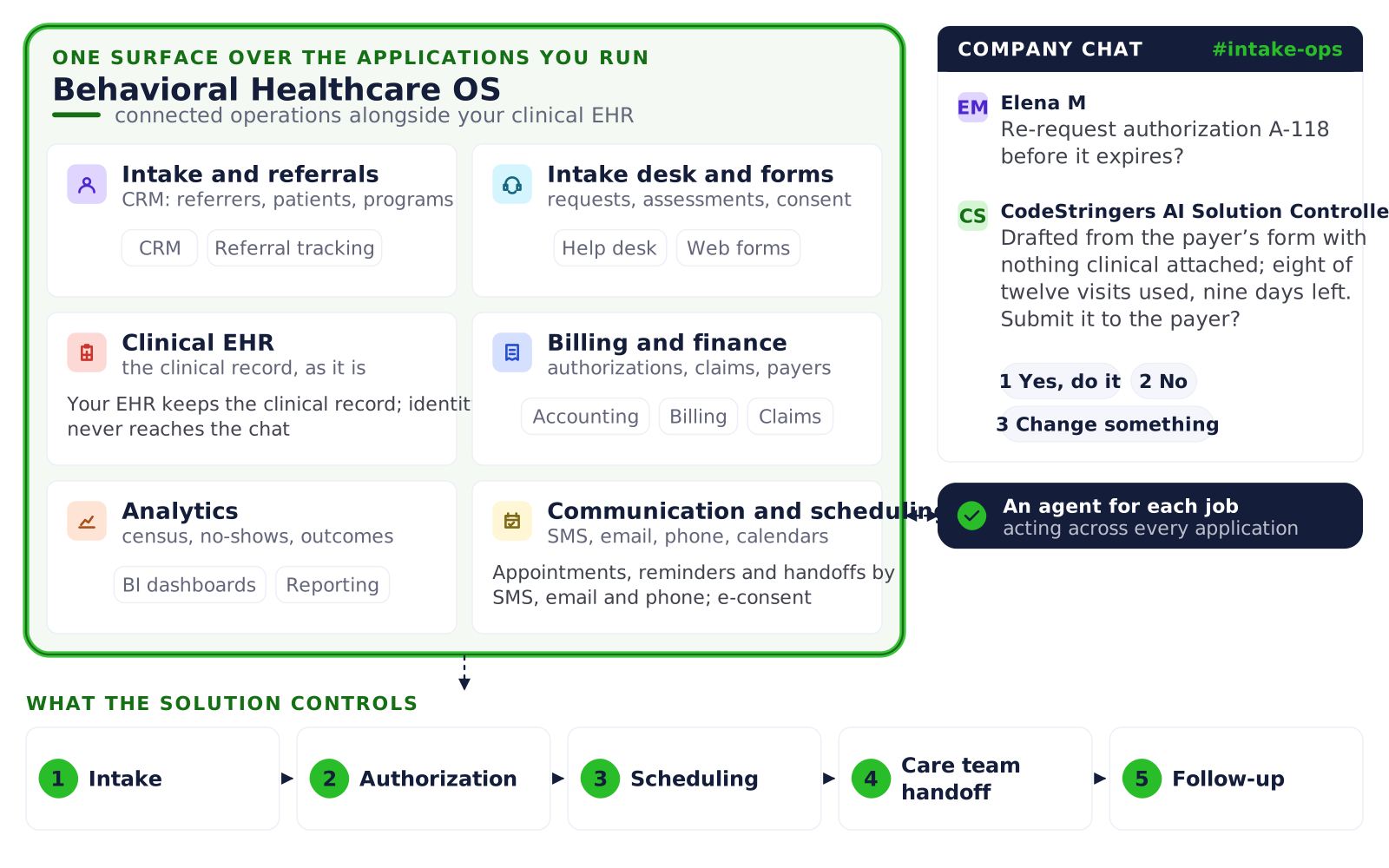
Architecture diagram of the Behavioral Healthcare OS: one surface over the operational applications a provider runs alongside its clinical EHR, six category boxes each naming the kinds of applications it runs on by category, never by vendor (intake and referrals: CRM, referral tracking; intake desk and forms: help desk, web forms; clinical EHR: your EHR keeps the clinical record; identity never reaches the chat; billing and finance: accounting, billing, claims; analytics: BI dashboards, reporting; communication and scheduling: appointments, reminders and handoffs by SMS, email and phone; e-consent), a company chat panel in which the AI agent drafts an authorization re-request with nothing clinical attached and asks whether to submit it, and the five workflow stages the solution controls: intake, authorization, scheduling, care team handoff, follow-up.

Behavioral Healthcare OS.

One Platform. Your End-to-End Workflow.

USE CASES

How Behavioral Healthcare Teams Create Better Operating Flow Without Replacing the EHR.

We help organizations coordinate what happens around the EHR - intake, referrals, scheduling, communication, and reporting - so staff can focus on care, not system gaps.

By aligning people, processes, and data in one system, teams get the structure and visibility they need to reduce delays, improve follow-through, and create a better experience for everyone.

5outcomes
  1. 01

    Operational workflows that fit the way teams work.

    Flexible tools shaped around your processes.

  2. 02

    Improved reporting and oversight.

    Dashboards that reflect operational reality.

  3. 03

    Better scheduling support.

    Optimize availability, reduce no-shows, and fill gaps.

  4. 04

    Faster follow-up and staff coordination.

    Reduce delays and keep nothing slipping through.

  5. 05

    Intake and referral visibility.

    See every referral, source, and status in real time.

AN OPERATING MODEL BUILT FOR BEHAVIORAL HEALTHCARE

An Operating Model Built for Behavioral Healthcare Providers.

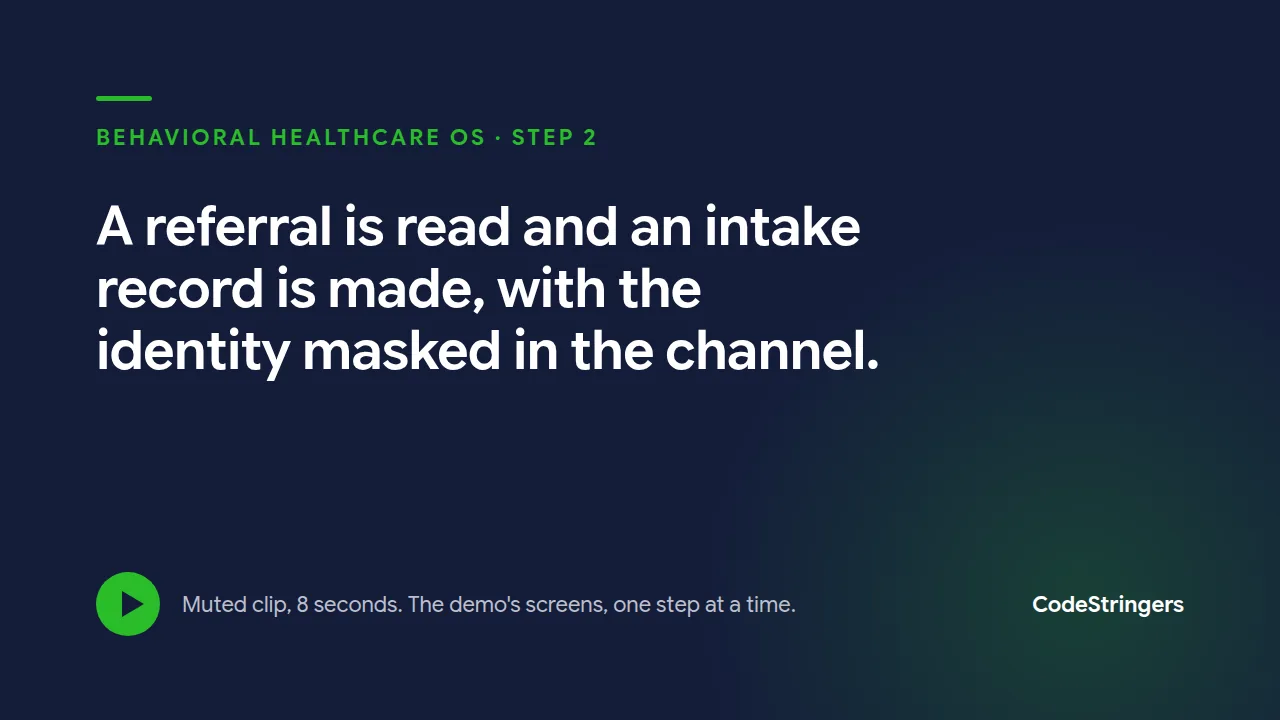
A referral is read and an intake record is made, with the identity masked in the channel.
See it runA referral is read and an intake record is made, with the identity masked in the channel.

Automation & Notifications.

Automate reminders, follow-ups, and status updates.

Compliance & Documentation Support.

Simplify documentation, consents, and audit readiness.

Reporting & Visibility.

Real-time dashboards for patient flow, outcomes, and operations.

Staff Workflows & Handoffs.

Ensure smooth transitions between intake, care teams, and support.

Scheduling & Coordination.

Streamline scheduling, reduce no-shows, and balance capacity.

Intake & Referral Management.

Capture, route, and nurture referrals with full visibility.

MORE THAN SOFTWARE

More Than an Integration Layer. An End-to-End Operating System.

We align people, processes, and data so your teams can operate with clarity, speed, and confidence.

Growth.

Scalable systems that support expansion.

Visibility.

See what is happening across your organization.

Automation.

Remove manual work and reduce errors.

Data.

Clean, connected data you can trust.

Process.

Standardize and improve how work gets done.

People.

Empower staff with the right information at the right time.

THE HARD PART IS NOT THE TECHNOLOGY

Where the Hard Part Isn’t the Technology. It’s the Disconnected Work.

People, processes, data, and applications accumulate independently. Over time, that creates confusion, rework, and risk.

We bring structure to the chaos so your organization can move forward together.

Visibility that drives accountability.
Reliable reporting and dashboards keep everyone aligned and focused on what matters most.
Leadership that compounds.
Better visibility helps leaders make better decisions - and builds confidence for continuously improving operations.
Process clarity that reduces friction.
We document, align, and improve how work gets done - so teams can focus on patients, not systems.
WHY IT MATTERS

Why This Role Matters More Than People Expect.

You're not just managing tools - you're creating the operational foundation your organization relies on to deliver better care and scale with confidence.

  • You help your organization deliver better outcomes.
  • You create operational discipline that scales.
  • You bring structure, clarity, and accountability.
  • You connect people, processes, and systems.
How a solution is delivered

What a managed solution includes.

You adopt the paradigm; we run it. Every solution we sell is a managed solution: the software, its integration to the platforms you already run, the people who keep it running, and the advice that keeps what goes into it sound. One subscription, four parts.

  • The software.

    The solution and its surface: the agents, the routines, the gates, and the record of every run. Released as versions, tested before each one reaches you.

  • The integration.

    Connected to the platforms you already run, CRM, marketing, finance, help desk, through their own APIs, with every write read back and logged.

  • Managed operations.

    The people and the monitoring that keep it running: connections tested daily, a regression fixed before you see it, upgrades applied, administration done, questions answered.

  • Advisory.

    The strategic work that keeps the inputs sound. A system runs what it is given, and poorly conceived themes produce failed campaigns, so a senior person reviews the plan, the targets and the results with you.

How it is sold

Licensed, which is the subscription for the software, and sold with managed services, billed as a monthly managed services fee, and advisory services. No hourly billing and no change order for a routine fix.

Who it is for

Operationally complex businesses that want the outcome run for them, not another application to staff. If what you need today is hours of configuration or integration work on your own platform, that is on our services pages and we take it on; the managed solutions are where we are going. Our services

Integrated

Also available as an integrated solution.

See the Behavioral Healthcare Solution Compare the three ways to work with us
Explore related capabilities

Analytics Integration Services.

Build dashboards that drive better decisions.

CRM Integration Services.

Unify referrals, intake, and outreach in one place.

Workflow & Automation Design.

Design and automate workflows that reduce admin burden.

Platform Integration Services.

Connect your business suite with your EHR and other essential systems.

Questions people ask.

Does behavioral health software like this replace the EHR?

No. The clinical record stays in the EHR. This operates around it: referrals, intake, eligibility and authorizations, scheduling, follow-up, communication and reporting, which are the workflows that usually live in spreadsheets, inboxes and fax. The control plane reads referrals for their operational fields and never holds clinical content. Keeping the EHR as the clinical system of record is what lets the operational layer change without touching care documentation.

How is patient identity protected in company chat?

Identity is masked by rule in every channel. The coordinator works from an intake number; the name stays in the CRM, visible to intake roles only, and never reaches the chat message. Nothing clinical is attached to a payer re-request. The system refuses to act on a record without consent on file and logs the refusal with its reason. Masking is enforced by the plane, not by staff remembering to leave details out.

How does it track authorizations?

Each authorization is held against the intake with its payer, expiry date and visits used. The plane watches both, drafts a re-request from the payer's form when an authorization is close to expiring or running out of visits, and posts it for a coordinator to approve with one keystroke. The denial that used to arrive in week six becomes a re-request in week one. Every submission is logged with who approved it.

What systems does it connect?

The CRM that holds intake and referral records, a help desk or forms tool, e-signature for consent, the accounting or billing partner, company chat, and email and fax intake. Connections run through each system's published APIs with keys from your own instance. The EHR is not integrated into the plane; it remains the clinical record alongside. A platform not yet connected is a small project for the first provider who asks.

What does implementation involve and how long does it take?

It starts with discovery: following a referral from receipt to first session to billing across your systems and showing where it stalls. Then the intake stages, the consent and authorization rules and the masking rules are configured to your programs and payers, connections are made to the applications you run, and coordinators are trained on the chat workflow. Timeline follows the number of programs, payers and systems; one program and one payer path goes live first.

What is included in the subscription?

The subscription is the license to the software, meaning the agents, the intake and authorization rules, the gates and the run log. It is sold with managed services and advisory services. Managed services cover the integration to your CRM, forms, e-signature, billing and chat, with connections tested daily and regressions fixed before you see them, for a monthly managed services fee. Advisory is a senior person reviewing intake flow and reporting with you.

NEED TO CAPTURE FIT?

See How a Connected System Could Fit Your Behavioral Healthcare Organization.

Let's explore your workflows, systems, and goals - and design an operating model that helps your team work better together.

Or just ask

Talk to us about this solution.

One question is enough. Say who you are and a person who has run this reads it and replies within one business day.

A new client, or thinking about becoming one
What are you looking for?
An agentic solution (AI OS) is licensed and sold with managed services. An integrated solution is built for a professional services fee. A Service is professional work, done by the hour, the month or the project. Not sure yet is a fine answer.

Agentic solutions (AI OS)

Integrated solutions

Services

Platforms You Use or Are Considering

Your details are never shared or sold.