Slow or Inconsistent Follow-Up.
New inquiries arrive, but the response depends on someone noticing and acting.
CodeStringers implements and integrates Zoho Marketing Automation as part of broader digital enablement solutions built around your audiences, buyer journeys, engagement signals, sales handoffs, and revenue outcomes. We connect Marketing Automation to CRM, websites, forms, SalesIQ, ecommerce, analytics, third-party systems, and custom software so marketing and sales work as one connected process.
 Zoho AuthorizedConsulting Partner
 Zoho and the Zoho logo are registered trademarks of Zoho Corporation.
A technically correct marketing automation setup can still fail the business if lead capture, segmentation, engagement, qualification, sales handoff, and reporting are not designed as one connected journey. The platform may send emails and track activity while prospects still receive generic follow-up, sales lacks context, and marketing cannot see what ultimately became pipeline or revenue.
The result is familiar: new leads that wait too long for a response, broad lists that ignore intent, disconnected campaign activity, weak lead qualification, brittle workflows, incomplete attribution, and marketing reports that stop at opens and clicks.
The problem usually is not whether Zoho Marketing Automation works. It is whether the buyer journey and the marketing-to-sales operating model were designed around real behavior, real handoffs, and measurable outcomes.
New inquiries arrive, but the response depends on someone noticing and acting.
Sales cannot see the engagement context that explains why a lead is ready—or not ready.
Marketing can report engagement, but cannot reliably connect activity to pipeline and revenue.
Every contact receives the same sequence regardless of fit, behavior, stage, or intent.
Journeys break when data, forms, CRM stages, ownership, or business rules change.
The strongest marketing automation solutions are designed around real audiences, real buyer journeys, real sales handoffs, and real measurement—not around a list of campaigns.
Marketing, sales, revenue operations, customer success, and the prospects and customers they engage.
How a prospect arrives, learns, engages, qualifies, is handed to sales, and becomes a customer who stays.
Scoring, lifecycle stages, consent, website behavior, form submissions, sales-ready thresholds, and the handoff to CRM.
Audiences, segments, journeys, scoring rules, forms, integrations, ownership, and the data that drives them.
Faster follow-up, better-qualified leads, cleaner marketing-to-sales handoffs, and revenue you can attribute.
Zoho Marketing Automation is the platform. The customer and revenue outcome is the goal.
Application expertise still matters. We configure Zoho Marketing Automation deeply so the platform supports the operating model we design around your business.
Structure lists, segments, lifecycle stages, custom fields, topics, subscription status, and audience data so campaigns operate from a reliable model.
Design triggered, multi-step journeys that respond to data, behavior, timing, goals, and changes in a contact’s stage.
Score contacts using fit and engagement signals so marketing and sales can distinguish curiosity from real buying intent.
Track meaningful website behavior, pages, goals, and visitor activity that can influence segmentation, scoring, and journeys.
Configure coordinated engagement across supported channels with timing and content aligned to audience and stage.
Connect website forms, signup experiences, pop-ups, landing interactions, and other capture sources to the right audiences and journeys.
Map CRM fields, synchronize relevant data, create or update CRM records, notify sales, create tasks, and establish clear qualification and routing rules.
Use demographic, firmographic, behavioral, lifecycle, CRM, and ecommerce data to create relevant audiences and experiences.
Organize campaign activity, goals, budget context, timelines, channel performance, and results around measurable marketing objectives.
Build dashboards, naming standards, consent rules, testing practices, data controls, and an optimization cadence that keeps automation trustworthy over time.
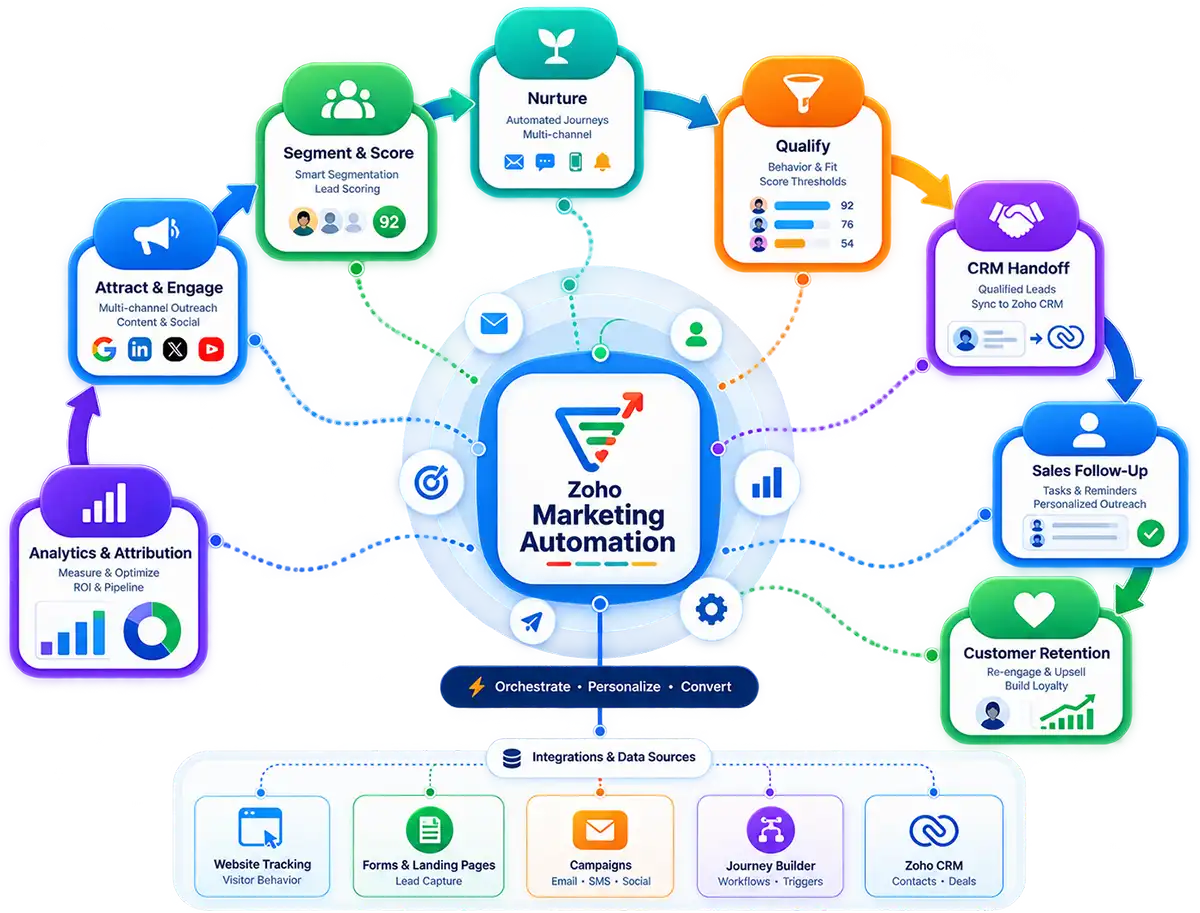
Zoho Marketing Automation can become the orchestration layer for audience engagement, nurturing, behavior tracking, lead qualification, and campaign activity. But marketing rarely owns the entire customer journey.
A prospect may discover you through search or advertising, convert on a website form, engage with content, chat through SalesIQ, enter a nurture journey, reach a qualification threshold, move into Zoho CRM for sales follow-up, become a customer through a proposal or commerce workflow, and later re-enter marketing for onboarding, cross-sell, retention, or re-engagement.
We design the complete journey first, then connect Marketing Automation to the applications and systems required to make that experience work end to end.
From first touch to sales-ready lead—and beyond—we connect the signals, systems, people, and handoffs behind the scenes.
Example: Content-to-Qualified-Opportunity Journey.
A prospect arrives from search, advertising, social, referral, or another source and converts through a form, landing page, chat, or event.
Marketing Automation uses source, profile, interests, and consent data to place the contact into the right audience and journey.
Email engagement, website activity, content interactions, form submissions, and other signals update segmentation and lead score over time.
When fit and engagement reach the agreed threshold, Zoho CRM is updated, ownership is assigned, and sales receives the context and next action.
The rep sees the prospect’s history, interests, source, score, and meaningful engagement instead of receiving a context-free lead.
CRM outcomes flow back into reporting so marketing can see what became pipeline, revenue, customers, and future nurture opportunities.
The prospect sees one relationship. Marketing and sales should see one connected journey—not a collection of disconnected campaigns and systems.
We do more than configure journeys and campaigns. We connect, extend, and operate the broader customer-acquisition and engagement solution your business depends on.
Deep Zoho Marketing Automation setup aligned to your audiences, buyer journeys, content, scoring, consent, and marketing processes.
Connect Marketing Automation to CRM, Forms, SalesIQ, websites, ecommerce, advertising, analytics, webinar tools, and external systems.
Use APIs, Zoho Flow, Creator, custom logic, data services, portals, and custom software where packaged functionality stops.
Support, monitor, test, troubleshoot, optimize, and continuously improve journeys, data flows, and marketing operations after go-live.
Design end-to-end customer and revenue solutions around people, journeys, data, handoffs, and business outcomes—not application boundaries.
Zoho Marketing Automation provides a strong engagement and nurture foundation. The complete solution may also require CRM, websites, ecommerce, advertising platforms, event tools, external data, analytics, and purpose-built software.
Marketing Automation, CRM, Forms, Sales IQ and more.
Wix, Wordpress, Advertising Networks and more.
Portals, Integrations, Data Feeds and more.
A connected customer-acquisition and engagement environment built around your audiences, workflows, data, sales handoffs, and revenue outcomes.
Buyer journeys, qualification criteria, data, and sales handoffs differ by business model. We combine marketing-automation expertise with knowledge of the workflows and operating requirements that matter in complex industries.
Marketing run as one governed system, from theme to lead.
Raise the ERP campaign to 55 a day; the leads are converting.
Budget proposal posted with the cap check. Your 1 applies it and I read it back.
From purchase order to margin by channel, one plant floor in chat.
Listings, deals with two sides, letters of intent and splits, from one message.
Referral to billing packet with identities masked by rule.
Tickets answered from knowledge, articles written as you solve, renewals seen early.
The operating model first, then one connected system on the platforms you already run.
The common denominator is not industry. It is operational complexity — and customer journeys that cross teams and systems.
End-to-end services that ensure your Zoho Marketing Automation solution is designed, implemented, integrated, extended, and optimized as part of the broader operating environment.
Map personas, lifecycle stages, buyer journeys, content needs, signals, qualification rules, handoffs, integrations, consent, and desired outcomes.
Configure audiences, fields, segments, journeys, scoring, forms, tracking, channels, permissions, governance, and reporting.
Connect Marketing Automation with Zoho CRM, Forms, SalesIQ, websites, ecommerce, analytics, event tools, APIs, and external data sources.
Clean, normalize, map, migrate, deduplicate, and structure contact, subscription, lifecycle, source, preference, and engagement data.
Build nurture, onboarding, re-engagement, qualification, event, lifecycle, and handoff journeys that respond to behavior and business rules.
Build Flow automations, Creator apps, APIs, middleware, enrichment services, custom forms, portals, and logic for requirements beyond native functionality.
Connect engagement, campaign, CRM, pipeline, and revenue data to create useful dashboards and improve marketing decision-making.
Support users, monitor integrations, maintain journeys, test changes, improve segmentation and scoring, and continuously optimize performance.
We help determine whether Zoho Marketing Automation is the right engagement platform—and whether Zoho Campaigns, another marketing platform, or a different architecture better fits the requirement.
Your business is unique. Your solution should be too. Not sure? We will evaluate the buyer journey and operating model first and recommend the right role for Zoho Marketing Automation—even if a simpler or different platform is the better answer.
Zoho Marketing Automation is a strong fit for many small and mid-sized businesses that need behavior-based nurturing, segmentation, scoring, website tracking, multi-step journeys, and tight integration with Zoho CRM. The right answer depends on your audience size, sales cycle, channels, content operations, data quality, integration needs, and the sophistication of the journeys you need to support.
Our services can include journey and solution design, Zoho Marketing Automation implementation, audience architecture, segmentation, scoring, website tracking, forms and capture, CRM integration, sales handoff rules, data migration, workflow automation, custom development, reporting, training, administration, and ongoing optimization.
Zoho Campaigns is often a good fit for email marketing, newsletters, and simpler campaign requirements. Zoho Marketing Automation is better suited to broader lifecycle automation that uses behavioral data, website activity, scoring, segmentation, multi-step journeys, and CRM-driven handoffs. We evaluate the use cases before recommending one or both.
The platforms can synchronize relevant CRM and marketing data so segmentation, journeys, scoring, and sales handoffs use shared context. Journeys can also update CRM data, create tasks, and support workflows that move qualified contacts into the sales process. We design the data mapping, ownership, qualification thresholds, and routing rules around your operating model.
Yes. Zoho Marketing Automation supports website tracking and goals that can help identify meaningful visitor behavior. That activity can inform segmentation, lead scoring, and automated journeys so follow-up reflects what a prospect actually did rather than treating every contact the same.
Yes. Contacts can be scored based on engagement and other criteria, and that information can be synchronized with CRM. We typically combine fit criteria with behavioral signals, define agreed qualification thresholds, and automate ownership, alerts, tasks, and handoff rules so sales knows when—and why—to engage.
Yes. We can connect Marketing Automation to Zoho Forms, SalesIQ, CRM, Commerce, Analytics, websites, ecommerce platforms, webinar and event tools, external databases, advertising data, APIs, and custom systems. The objective is a connected buyer journey, not a collection of isolated connectors.
Yes. We can plan and execute migration of contacts, fields, lists, segments, subscription and preference data, and other relevant marketing data where practical. Migration is also an opportunity to clean duplicates, standardize fields, improve consent and audience architecture, and avoid reproducing the old platform’s problems in the new one.
Yes. We can assess audience structure, CRM synchronization, journeys, scoring, forms, website tracking, content logic, permissions, consent, reporting, and operational ownership. We then redesign the areas causing weak engagement, broken handoffs, unreliable data, or automation that the team no longer trusts.
Yes. We can extend the solution with Zoho Flow, Creator, APIs, middleware, custom forms and portals, data enrichment, specialized attribution logic, external services, and purpose-built software when the customer journey requires functionality outside the application itself.
Yes. We provide ongoing administration, integration monitoring, journey maintenance, segmentation and scoring refinement, reporting improvements, troubleshooting, testing, release management, user support, and continuous optimization so the marketing system evolves with the business.
A typical consultant may focus primarily on campaigns, email, or configuring the marketing platform. CodeStringers combines Zoho expertise with CRM integration, systems architecture, workflow design, custom software development, data integration, and ongoing technical operations. We treat Marketing Automation as one component of a larger digital enablement solution built around the complete customer and revenue journey.
Zoho Campaigns is an email marketing tool for sending newsletters and simple autoresponders to lists. Zoho Marketing Automation adds the pieces a buyer journey needs: multi-step journeys that react to behavior, lead scoring, website tracking, lead-capture forms and pop-ups, and multichannel messaging. A business that only sends scheduled emails is usually fine on Campaigns. A business that needs to qualify leads and hand them to sales with context needs Marketing Automation.
Lead scoring assigns points for two kinds of signal. Fit signals come from profile data such as industry, role or company size. Engagement signals come from behavior such as email clicks, page visits, form submissions and event attendance. Points can also decay after a period of inactivity. When a contact crosses an agreed threshold, a journey can tag the contact, update the CRM and alert sales. The threshold should be agreed with sales before the scoring model is built.
Yes. Website tracking works through a tracking script added to any site, and forms can be embedded or connected through webhooks and the API. Page visits, goals and form submissions then attach to known contacts once they identify themselves through a form or a tracked email link. Consent banners and cookie rules apply, so the tracking setup is planned together with the privacy policy rather than after it.
A single-journey setup with clean contact data and an existing CRM typically takes weeks rather than months. A build that includes audience migration, scoring, several journeys, website tracking and integrations with ecommerce or event tools takes longer, because each integration and each journey needs testing with real data. The biggest schedule risk is usually content: a journey cannot launch until the emails, forms and landing pages it sends are written and approved.
Four things shorten the build. A list of audiences and the lifecycle stages a contact moves through. A record of consent and subscription status for every contact being migrated, since importing contacts without consent creates deliverability and legal risk. The qualification rule sales will accept for a handoff. And the content each journey sends. A short inventory of the current tools, forms and website platforms also tells the implementer what has to be integrated.
We write your systems’ configuration as code and let AI apply it: fields, picklists, layouts, workflow rules, integrations, read back and verified after every step, so a build that took weeks of clicking takes days.
Because the work is programmatic, we quote the outcome, not the hours. The estimate is guaranteed and discovery is no-risk.
Our own Zoho CRM rebuild in October 2026: 21 shared picklists, 3 modules, 88 fields, 7 layouts, 23 workflow rules and 16 actions, built in the sandbox through code in 22 verified runs, every step read back.
The same tools that configure your systems today are what run our agentic solutions tomorrow: one surface over the systems you already own. See the agentic solutions
Where we're not the right answer
Your primary requirement is newsletters, basic email campaigns, and simple sequences that Zoho Campaigns can handle more simply. Your warehouse requires a sophisticated standalone WMS with advanced labor, wave, yard, robotics, or automation controls.
We will start with your audiences, buyer journeys, engagement signals, sales handoffs, content, integrations, and data, then show you where Zoho Marketing Automation fits and what the complete solution needs to turn engagement into measurable business outcomes.