
eCommerce integration.
Connect storefronts to the rest of your stack.
Tübr Storage designs and manufactures premium airtight, waterproof storage containers built around a patented Double O-Ring System. Their product line — the Stash, Kingz, Gordo, and Alümen — is crush-proof, odor-proof, and IP65 weather-resistant, with enough engineering behind them to float if submerged. The brand has attracted celebrity partnerships with Marlon Wayans, cigar brand La Aurora, Breezy Golf, and Bingham’s Bourbon, and has launched limited-edition collections including a 2026 Soccer World Cup series.
Tübr operates a multi-channel business: direct-to-consumer eCommerce through its online storefront, direct B2B sales, and a growing reseller network. On the back end, raw parts and materials arrive from overseas vendors (DA Sun and Ningbo Huanya in China), are assembled into finished goods, and then handed off to OIA Global Fulfillment Systems — their third-party logistics (3PL) partner — for storage, pick-and-pack, and shipping.
By mid-2025, Tübr had already cleared what the startup world calls Gate 2 — establishing product-market fit and generating repeatable revenue. They were in the top 10% of consumer product startups that reach that milestone. The challenge wasn’t survival anymore. It was scale.
Scaling a light manufacturing and 3PL operation is operationally complex in ways that most business software isn’t built to handle out of the box. Tübr needed a unified system that could simultaneously:
Tübr selected CodeStringers for their ability to understand not just the technology, but the business itself — mapping end-to-end workflows across light manufacturing, eCommerce, and third-party logistics and translating that understanding into a single, holistic solution rather than a patchwork of disconnected implementations.
CodeStringers is a business systems integrator based in Santa Cruz, California, with a wholly-owned delivery center in Vietnam and more than 12 years delivering business systems transformation. Their vertical focus areas are purpose-built for exactly what Tübr needed: light manufacturing, eCommerce, and third-party logistics — combined in a single engagement, not treated as separate specializations bolted together.
Critically, CodeStringers doesn’t just configure software. They lead engagements at the C-level through their Fractional CxO model, providing strategic technology leadership alongside hands-on implementation. For a lean company like Tübr, this meant having senior-level IT strategy without the overhead of a full-time executive.
Their engagement approach also distinguished them: a no-risk discovery phase before any estimates or commitments are made, project guarantees capped to estimates, and Kaizen-based continuous improvement baked into their delivery process rather than treated as an afterthought.
CodeStringers designed and implemented a full business systems stack on one integrated suite, architected around Tübr’s actual operational reality — not a generic eCommerce template.
Solution Architecture.
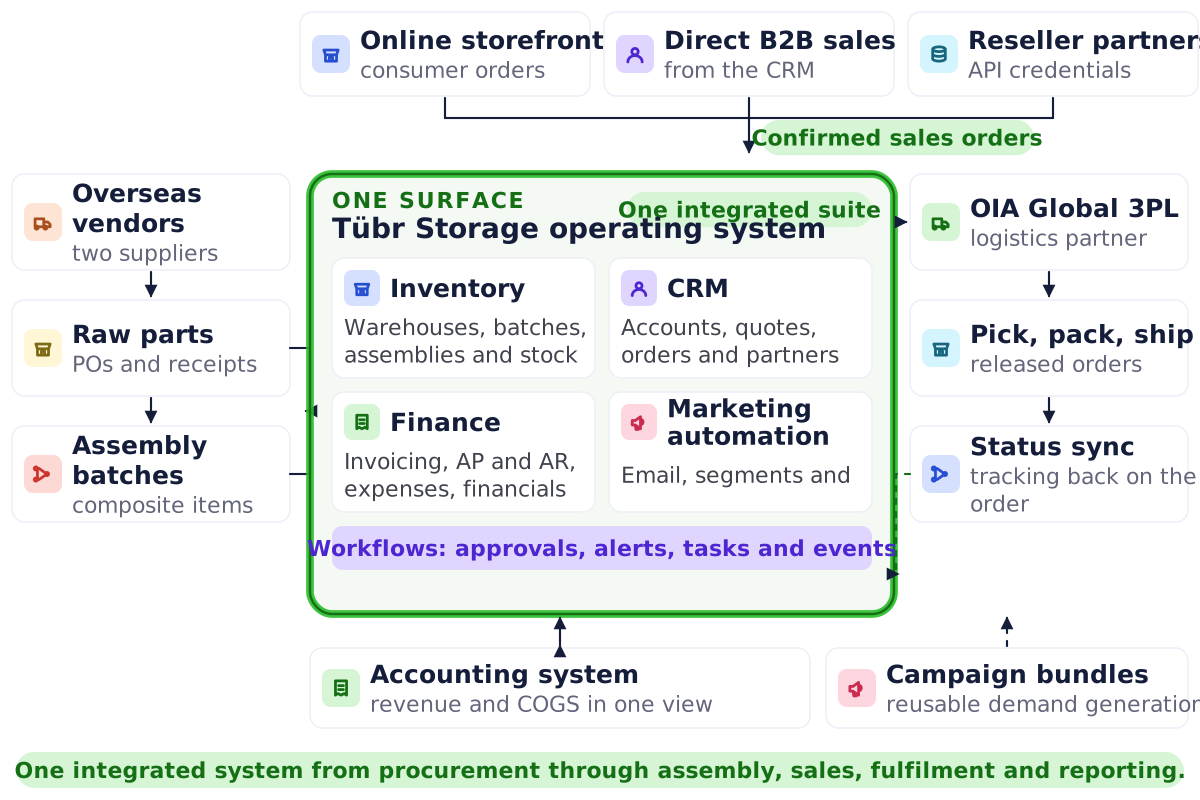
At the core of the solution is the inventory application configured for light manufacturing. CodeStringers set up a dual-purpose item structure that distinguishes between inventory assets (raw parts and materials) and finished goods (sellable products). Assembly Composite Items serve as batch templates — defining exactly how many units of each raw component are consumed to produce a single finished product. When a production run happens, an assembly transaction fires: inventory assets are decremented, finished goods are incremented, and the system stays accurate without manual reconciliation.
This was not a standard inventory deployment. It required custom workflows, transfer order logic, automated notifications, and reporting layers specific to Tübr’s manufacturing model.
The integration between the inventory application and OIA Global Fulfillment Systems was the most technically demanding component of the engagement. When a sales order is confirmed — whether from the online storefront, a direct B2B customer, or a reseller — it automatically flows from the inventory application to OIA’s fulfillment systems, triggering pick-and-pack operations and generating fulfillment status updates that sync back into the inventory application in real time. This integration ultimately took three times the initially estimated hours due to undiscovered complexity in OIA’s systems, a challenge CodeStringers absorbed transparently and resolved without passing unexpected costs to Tübr.
The inventory application connects directly to Tübr’s online storefront, keeping product listings, inventory availability, and order data synchronized across both systems. The architecture also supports Tübr’s reseller channel: an API gateway issues partner-specific API credentials to resellers, enabling secure, authenticated integration between Tübr’s systems and each reseller’s own eCommerce and CRM platforms. Direct B2B sales are managed through the CRM, with opportunity tracking and order management integrated into the same suite.
The accounting application connects to the company’s accounting system, ensuring that income, expenses, and cost-of-goods-sold data flow cleanly into Tübr’s financial reporting without double entry. Purchase order transactions from overseas vendors, fulfillment costs from OIA, and revenue from all sales channels are reconciled in a single financial view.
Alongside the operational systems, CodeStringers built marketing automation infrastructure to support Tübr’s demand generation programs — including the promotional bundling and campaign tooling needed to run holiday promotions and multi-product offers. The infrastructure was designed as a reusable asset, allowing future campaigns to be launched on top of the same foundation without rebuilding from scratch each time.
Rather than a one-off project delivery, CodeStringers proposed and transitioned Tübr to a managed services model — a subscription-based arrangement that provides a committed pool of monthly hours drawn from across CodeStringers’ team of specialists. Graphic design, website development, business systems integration, custom software development: all of it draws from the same monthly bucket, with rollover provisions for unused hours.
The managed services model replaced the unpredictability of ad hoc project pricing with a fixed monthly investment and guaranteed resource availability — a critical advantage for a fast-moving company that can’t afford to wait weeks for vendor capacity to free up.
Tübr now operates a unified, end-to-end business system that connects procurement from overseas vendors through light manufacturing, multi-channel order management, 3PL fulfillment, and financial reporting — all on one integrated suite.
Where their previous implementation partner reached a dead end, CodeStringers delivered a working system purpose-built for the complexity of Tübr’s actual operations.
Equally important: the foundational architecture is now in place to support Tübr’s next growth phases — direct B2B expansion, reseller channel scaling, new product development, and event sales — without starting over.
Most eCommerce platforms are designed for retailers, not manufacturers. Most 3PL integrations are built for distributors, not assembly-based businesses. And most implementation partners, even excellent ones, specialize in one area — CRM, or eCommerce, or ERP — rather than the full stack required when all three intersect.
If your business assembles products, ships through a 3PL, and sells across multiple channels, the complexity compounds fast. Off-the-shelf configurations won’t cut it. You need a partner who has built this before.
CodeStringers has.
Business application platforms are the foundation. Our solutions are built user experience and workflow first, features second: a CRM is a CRM, and the platform you already run is the one we build on. Zoho is our partner; the rest we support through their published APIs, with the keys coming from your own instance in production. A platform we have not connected yet is a small project for the first customer who asks.





























A retail inventory system tracks finished goods in and out. A manufacturing one also tracks the raw parts and materials, holds a bill of materials for each product, and records assembly runs that consume components and create finished units. It separates the two stock types in reporting, costs the finished goods from the components, and knows which parts to reorder when sales forecasts change. Without that layer, assembly is reconciled by hand in spreadsheets.
When an order is confirmed in the inventory system, the integration sends it to the third-party logistics provider's warehouse system with the items, quantities and shipping details. The 3PL picks, packs and ships, and sends status and tracking back, which the integration writes to the order. Stock on hand at the warehouse is synchronised on a schedule so the storefront never sells what is not there. Returns and receipts of new stock flow the same way.
One system holds the stock count and every channel reads from it. The storefront syncs product and availability data and pushes orders in. B2B orders are entered through the CRM or an order form against the same items. Resellers connect through an API gateway with their own credentials, so each partner's orders and stock queries are authenticated and logged separately. Allocation rules decide which channel's orders are fulfilled first when stock is short.
Buy when a packaged inventory application with a manufacturing module covers the bill of materials, assembly and channel integrations you need, which is the case for most light manufacturers. Build custom only for the gaps: a reseller API, a specific 3PL protocol, or a costing rule the package cannot express. Configuring and integrating a packaged system usually costs less and arrives sooner than building, and leaves the vendor responsible for the core.
The inventory application records purchase orders, receipts, assembly runs and sales; the integration posts the financial effects to the accounting system as bills, invoices, inventory asset adjustments and cost of goods sold. Fulfilment charges from the 3PL arrive as bills against the orders they served. Each transaction carries a reference so the two systems can be reconciled. The result is one financial view across procurement, manufacturing and every sales channel without double entry.
A managed services model replaces one-off project quotes with a monthly subscription that covers a committed pool of hours across the skills a company needs, such as systems integration, custom development, design and website work. Unused hours may roll over within limits. The company gets guaranteed capacity and a predictable monthly cost; the provider owns the backlog and the response times. It suits companies whose systems change continuously but who do not want a full in-house team.
Connect storefronts to the rest of your stack.
Keep stock, orders and fulfillments in agreement.
Capture leads and make follow-up unavoidable.
Dashboards you can actually trust.
“Something isn’t working.” “We’re outgrowing our tools.” “We’re afraid to make the wrong move.” No-Risk Discovery is a short, practical conversation that gets you clarity before you commit to anything big. We’ll tell you if we’re a fit. If we’re not, we’ll tell you that too.