INTEGRATED BUSINESS SOLUTION FOR COMMERCIAL BROKERAGES

Commercial Real Estate Software for Brokerages Running Complex Deals.

Commercial brokerages rarely struggle because they lack opportunities. They struggle because each transaction can involve multiple parties, documents, approvals, follow-ups, deadlines, and handoffs — all moving at different speeds.

  • Transaction-first design
  • Platform-agnostic architecture
  • Built for visibility and scale
  • Scalable for Growth
Commercial Brokerage OS: the AI control plane we build, over the platforms it runs on and delivering through the channels to brokerages running complex deals.Three layers, read bottom to top: the platforms it runs over (CRM and deals, Marketing automation, Finance, Documents and e-signature, Listing data and portals, Analytics); the control plane, Commercial Brokerage OS, with its capabilities (Listing, Deal, Documents, Close, Commission, Human gates); and the channels it delivers through (Listing portals, Email, Company chat, E-signature, Reports), reaching brokerages running complex deals.RUNS OVER THE PLATFORMS YOU ALREADY HAVECRM and dealsMarketing automationFinanceDocuments and e-signatureListing data and portalsAnalyticsWHAT WE BUILD: THE AI CONTROL PLANECommercial Brokerage OSListingDealDocumentsCloseCommissionHuman gatesDELIVERS THROUGHListing portalsEmailCompany chatE-signatureReportsBrokerages running complex deals Commercial Brokerage OS: the AI control plane we build, over the platforms it runs on and delivering through the channels to brokerages running complex deals.Three layers, read bottom to top: the platforms it runs over (CRM and deals, Marketing automation, Finance, Documents and e-signature, Listing data and portals, Analytics); the control plane, Commercial Brokerage OS, with its capabilities (Listing, Deal, Documents, Close, Commission, Human gates); and the channels it delivers through (Listing portals, Email, Company chat, E-signature, Reports), reaching brokerages running complex deals.RUNS OVER THE PLATFORMS YOU ALREADY HAVECRM and dealsMarketing automationFinanceDocuments and e-signatureListing data and portalsAnalyticsWHAT WE BUILD: THE AI CONTROL PLANECommercial Brokerage OSListingDealDocumentsCloseCommissionHuman gatesDELIVERS THROUGHListing portalsEmailCompany chatE-signatureReportsBrokerages running complex deals
AI-driven integrated business solutions

The AI control plane.

Commercial Brokerage OS is an AI control plane above the CRM's two-sided deal, e-signature, files and accounting. A listing is created from one message; buyers are matched; the LOI is drafted from the deal and sent for signature on your 1; commissions compute from the split rules. Brokers talk; the system files.

As volume grows, spreadsheets, inboxes, shared drives, and generic CRM pipelines become the operating system by accident. CodeStringers builds connected digital enablement solutions for commercial brokerages designed around the complete seller, buyer, deal, and transaction journey.

Company chat #deal-desk
#deal-deskCompany chat
  1. Daniel R

    New listing: 12,000 sq ft flex at 1400 Industrial Way, asking 2.1M, owner Acme Holdings.

  2. CodeStringers AI Solution Controller

    Property, listing and owner-side deal created. Copy drafted, syndication proposed. Publish?

    1 Yes, do it2 No3 Change something
  3. Daniel R

    Prepare the LOI at 1.95M, 60-day due diligence, buyer Harbor Logistics.

  4. CodeStringers AI Solution Controller

    Draft in the deal room. Three terms missing: deposit, closing, contingencies. Then your 1 sends it for e-signature.

    1 Yes, do it2 No3 Change something
  5. Daniel R

    What is my split on Harbor if it closes at 1.95?

  6. CodeStringers AI Solution Controller

    Computed from the rule set: posted in the thread, booked in Books at close.

CRM, documents, e-signature and financeOur skin of the deal
Listing L-⁠0418CRM
1400 Industrial Way, flex, 12,000 sq ft
Owner-side deal
D-⁠0931, Acme Holdings
Asking
2.1M, 90-day window
Deal room
Deal Rooms / 1400 Industrial Way, 14 photos filed
Marketplace 1
queued live
Marketplace 2
queued live
Brokerage site
queued live

Logged. publish L-⁠0418 to 3 targets, approved by Daniel at 9:16.

Letter of intent, D-⁠0931E-signature
envelope SG-⁠2207, Harbor Logistics and Acme Holdings
Price
1,950,000, from deal D-⁠0931
Due diligence
60 days
Deposit
missing 50K
Closing date
missing 30 days after DD
Contingencies
missing financing, environmental
Status
Draft Sent 3:16

Both sides watched. When one side moves, the other side's next step lands in the thread.

Commission on D-⁠0931 at 1.95MFinance
computed from the split rules
Gross commission
5 percent of 1,950,000: 97,500
Co-broker
50 percent of gross: 48,750
House, Northpoint Commercial
40 percent of the remainder: 19,500
Daniel R
60 percent of the remainder: 29,250
Split policy
inside policy, a 1 books it at close

From the day the deal opens. Recomputed whenever the price or the terms move; the same lines answer the broker in chat.

Run log

  1. beat 1Property, listing and owner-side deal created. Copy drafted, syndication proposed. Publish?
  2. beat 2Draft in the deal room. Three terms missing: deposit, closing, contingencies. Then your 1 sends it for e-signature.
  3. beat 3Computed from the rule set: posted in the thread, booked in Books at close.
  1. What it controls.

    New listing: 12,000 sq ft flex at 1400 Industrial Way, asking 2.1M, owner Acme Holdings.

    CRM · e-signature · files · accounting · marketing automation · company chat

  2. Governance designed in.

    Prepare the LOI at 1.95M, 60-day due diligence, buyer Harbor Logistics.

    Every dollar has a gate a person controls, caps are enforced in code below the gate, every action is logged with who approved it, and no credential is ever visible to a person or a prompt. The screens stay for administrators, reports and dashboards; the work moves to the conversation.

  3. Company chat.

    What is my split on Harbor if it closes at 1.95?

    Works in the chat your team already uses. Email and other channels with an API on request.

  4. The ladder

    Agentic orchestration.

    Configured applications, then integrated solutions, then agentic orchestration. The control plane is the third rung, and this page is what it looks like in your industry.

    1. Configured applications
    2. Integrated solutions
    3. Agentic orchestration
    Watch the Demo Video
THE HIDDEN OPERATIONAL COST

The Hidden Costs of Disconnected Brokerage Operations.

A brokerage can have strong producers, experienced operators, and plenty of opportunity — and still lose capacity because the work between people and systems is fragmented. The symptoms usually show up as administrative drag, inconsistent follow-up, missing context, and leadership spending too much time asking for status.

6hidden costs
  1. 01

    Operational Drag.

    Too much time is spent chasing updates, reconciling information, and coordinating handoffs instead of moving transactions forward.

  2. 02

    Limited Visibility for Leadership.

    Pipeline health, stalled transactions, outstanding documents, workload, and performance are difficult to see without manual reporting.

  3. 03

    Disconnected Buyer/Seller Activity.

    Seller-side and buyer-side journeys move independently, making it difficult to understand relationships, matches, and cross-deal dependencies.

  4. 04

    NDA & Document Bottlenecks.

    NDAs, LOIs, contracts, amendments, approvals, and signatures become manual coordination work instead of a controlled workflow.

  5. 05

    Fragmented Broker Workflow.

    Brokers juggle contacts, listings, buyers, activities, and documents across tools that were never designed to behave like one process.

  6. 06

    Deal Status Uncertainty.

    Teams cannot answer “Where does this deal stand?” without checking email, spreadsheets, shared drives, or individual people.

IT IS NOT JUST LEAD MANAGEMENT

You're Not Managing Leads. You're Managing Transactions.

CRM matters. It gives a brokerage a structured way to manage relationships, opportunities, communication, and pipeline activity. But a commercial brokerage transaction does not stop when an opportunity becomes real. That is when the operational complexity often begins.

A single transaction may require seller representation, buyer qualification, property or business data, NDAs, contracts, due diligence, tasks, approvals, document exchange, commissions, reporting, and constant communication among multiple parties. The solution has to manage the journey across those boundaries — not force the business to live inside one application.

The real goal is transaction visibility.

A CRM can tell you who the customer is. A connected brokerage operating system should also tell you what is happening, who owns the next step, what is blocking progress, and what needs attention today.

  • Real-time reporting that shows what is moving, what is stuck, and what needs attention.
  • Automated reminders, approvals, notifications, and follow-up.
  • Role-based work queues for brokers, operators, and leadership.
  • Centralized documents, NDAs, contracts, and communications.
  • Structured workflows for seller-side, buyer-side, and transaction activity.
  • End-to-end visibility from inquiry through close.
CONNECTED BROKERAGE ARCHITECTURE

The Connected Brokerage OS.

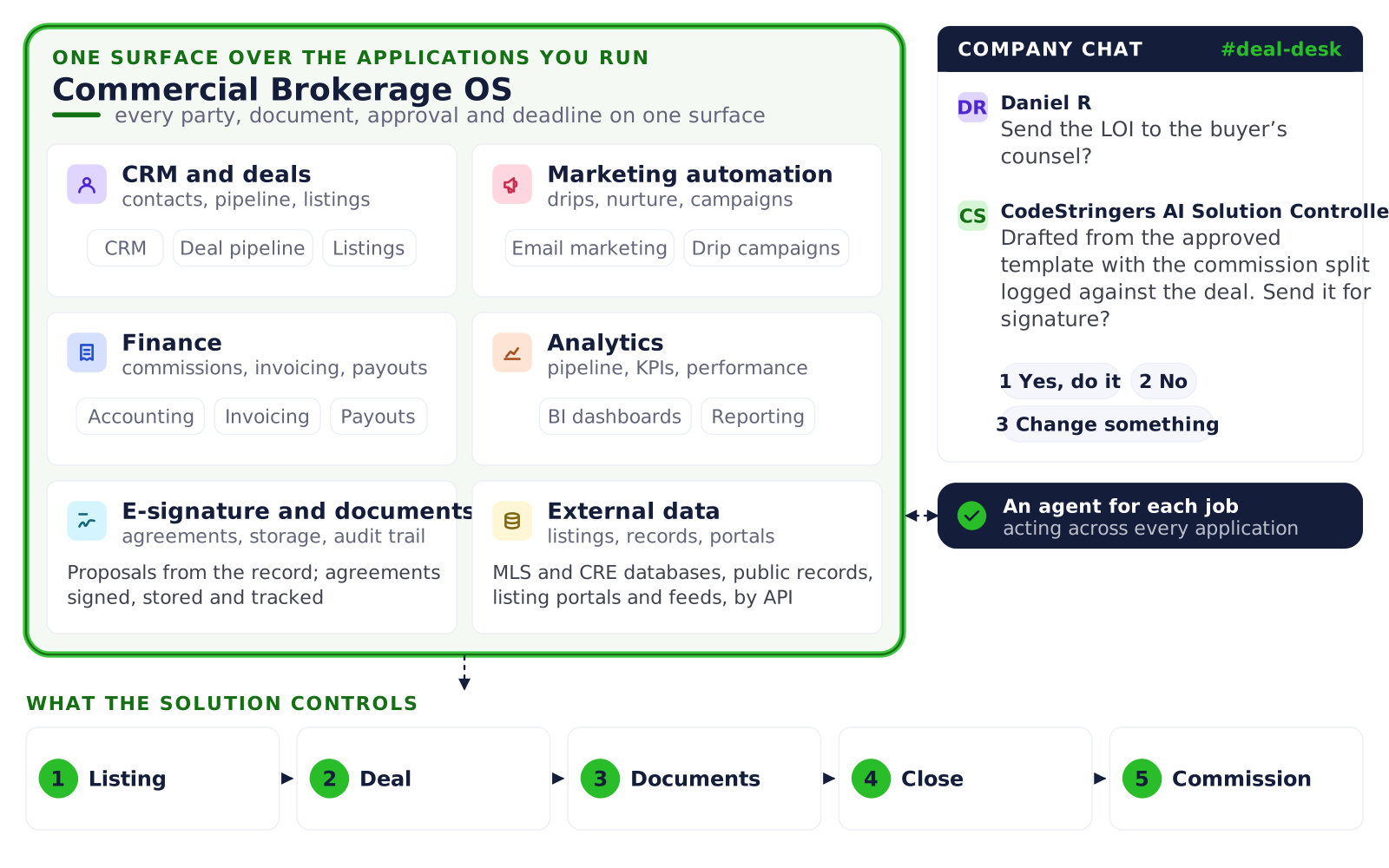
Architecture diagram of the Commercial Brokerage OS: one surface over the applications a brokerage runs, six category boxes each naming the kinds of applications it runs on by category, never by vendor (CRM and deals: CRM, deal pipeline, listings; marketing automation: email marketing, drip campaigns; finance: accounting, invoicing, payouts; analytics: BI dashboards, reporting; e-signature and documents: proposals from the record; agreements signed, stored and tracked; external data: MLS and CRE databases, public records, listing portals and feeds, by API), a company chat panel in which the AI agent drafts a letter of intent and asks whether to send it for signature, and the five workflow stages the solution controls: listing, deal, documents, close, commission.

Commercial Brokerage OS.

One Platform. Your Entire Brokerage.

REAL IMPACT

How Addiction-Rep Turned a Complex Brokerage Process Into One Connected Operating System.

Addiction-Rep operates in a specialized commercial brokerage market where deals are long-cycle, confidential, document-intensive, and involve multiple parties with different journeys. Generic pipelines could not reflect how the business actually worked. Inquiries arrived from multiple channels, NDAs were managed through email, follow-up depended too heavily on memory, and leadership lacked a single view of listings, buyers, deal status, and risk.

CodeStringers designed a Brokerage Operating System on one integrated suite around those real-world workflows. The solution uses a purpose-built multi-pipeline CRM architecture, automated NDA generation and signature through document generation and e-signature, inbound-call and lead-import integrations, task-based follow-up, marketing automation, and analytics reporting. Rather than forcing the brokerage into a conventional sales funnel, the system manages sellers, buyers, listings, documents, tasks, and deal stages as one connected operating process.

The result is a structured system in which every inbound inquiry enters a defined workflow, follow-up is assigned and automated, sensitive documents move through controlled processes, and leadership can see the health of the brokerage from a single reporting layer. The architecture is also designed to support additional brokers, service lines, and deal volume without rebuilding the operating model from scratch.

4outcomes
  1. 01

    One View of the Business.

    Leadership can see active listings, buyer engagement, deal stages, NDA status, and task completion from a shared reporting layer.

  2. 02

    No Silent Deal Stalls.

    Overdue milestones and missed follow-up can trigger structured tasks and reminders instead of disappearing into inboxes or memory.

  3. 03

    NDAs in Minutes, Not Days.

    Automated document generation and e-signature workflows reduce the friction of preparing, routing, executing, and filing NDAs.

  4. 04

    Defined Intake for Every Inquiry.

    Every inbound inquiry enters a defined pipeline with documented workflow, task ownership, and follow-up.

WHAT THE OPERATING MODEL DOES

An Operating Model Built for Commercial Brokerage.

The technology should reduce transaction friction, not create another place for people to update. We design the operating model around the repetitive work, exceptions, decision points, and handoffs that determine whether deals move smoothly or stall.

A new listing from one message: the property, the listing and the owner-side deal are created and linked.
See it runA new listing from one message: the property, the listing and the owner-side deal are created and linked.

Connect Sales to Delivery.

Carry context from relationship development into contracts, transaction execution, financial workflows, and post-close activity without re-keying information.

Standardize Follow-Up.

Create consistent communication, nurture, reminders, and escalation patterns so opportunities do not depend on memory.

Improve Operational Visibility.

Give brokers, operations, and leadership role-appropriate views of deal health, workload, bottlenecks, and performance.

Manage Due Diligence.

Track required tasks, documents, approvals, milestones, and deadlines so critical steps are visible and accountable.

Simplify Complex Commercial Workflows.

Structure seller-side, buyer-side, listing, deal, and transaction workflows with clear stages, owners, rules, and next actions.

Automate Administrative Work.

Automate follow-up, reminders, notifications, task creation, status changes, reporting, and other repeatable work.

MORE THAN A CRM

More Than a CRM. An Operating System.

CodeStringers Brokerage OS is not a packaged SaaS product and it is not a generic CRM template. It is a solution framework we configure and extend around the specific people, processes, transactions, and data model of each brokerage.

The common architecture is reusable. The implementation is not one-size-fits-all. We use the platform, workflow patterns, integrations, and lessons learned from prior brokerage work to accelerate design while still building around how your firm actually operates.

Growth.

A scalable foundation that can support more brokers, transactions, channels, and service lines without rebuilding the business system.

Visibility.

Dashboards and operational views that show what is moving, what is stuck, and what requires attention.

Automation.

Rules, reminders, task creation, approvals, notifications, routing, and integrations that make the process repeatable.

Data.

One governed relationship and transaction model instead of duplicated records and competing spreadsheets.

Process.

Seller, buyer, listing, document, transaction, due-diligence, and close workflows designed as connected journeys.

People.

Role-based experiences for owners, brokers, agents, operations, finance, and leadership.

THE HARD PART IS NOT THE TECHNOLOGY

Where the Hard Part Isn't the Technology. It's the Disconnected Work.

Most firms already have technology. The problem is that people, processes, data, and applications have accumulated independently. The work between them is where friction appears: manual handoffs, duplicated data, inconsistent follow-up, hidden exceptions, and status meetings required simply to understand what is happening.

Our job is to design the operating model first, then use your applications and the surrounding technology to make that model executable, measurable, and easier to operate.

Leadership + Accountability.
Give owners and managers the visibility and ownership model required to keep the system aligned as the brokerage grows.
Automation That Compounds.
Automate repeatable work only after the process is clear, so every transaction benefits from the same discipline.
Process Clarity.
Define the journey, responsibilities, decisions, exceptions, and required information before automating anything.
WHY CODESTRINGERS

Why This Role Matters More Than People Expect.

Technology decisions compound. Once systems are in place, changing direction becomes expensive, workarounds become permanent, and small design mistakes spread into daily operations. That is why the brokerage needs more than someone who knows how to configure software.

CodeStringers combines solution architecture, platform expertise, systems integration, custom software development, and ongoing technical operations. We help your team make explicit tradeoffs and keep the system aligned with how the business actually runs.

  • Systems designed to scale instead of accumulating new workarounds.
  • Happier clients, partners, and employees through clearer workflows.
  • Stronger broker and operations accountability.
  • Better decisions with better operational data.
How a solution is delivered

What a managed solution includes.

You adopt the paradigm; we run it. Every solution we sell is a managed solution: the software, its integration to the platforms you already run, the people who keep it running, and the advice that keeps what goes into it sound. One subscription, four parts.

  • The software.

    The solution and its surface: the agents, the routines, the gates, and the record of every run. Released as versions, tested before each one reaches you.

  • The integration.

    Connected to the platforms you already run, CRM, marketing, finance, help desk, through their own APIs, with every write read back and logged.

  • Managed operations.

    The people and the monitoring that keep it running: connections tested daily, a regression fixed before you see it, upgrades applied, administration done, questions answered.

  • Advisory.

    The strategic work that keeps the inputs sound. A system runs what it is given, and poorly conceived themes produce failed campaigns, so a senior person reviews the plan, the targets and the results with you.

How it is sold

As a subscription: one monthly price for the software, the integration, the operations and the advice, in tiers for each solution set by how much of it you use in a month. No hourly billing and no change order for a routine fix.

Who it is for

Operationally complex businesses that want the outcome run for them, not another application to staff. If what you need today is hours of configuration or integration work on your own platform, that is on our services pages and we take it on; the managed solutions are where we are going. Our services

Explore related capabilities

Fractional CxO Leadership.

Senior technology and systems ownership to align architecture, process, investment, priorities, and long-term scale.

Custom Applications.

Portals, workflow applications, integration services, and purpose-built interfaces where packaged software does not fit.

Business Intelligence.

Operational dashboards and analytics that answer where deals are stuck, what needs attention, and how the brokerage is performing.

CRM Platform.

Relationship, account, contact, lead, pipeline, and deal architecture configured around brokerage workflows.

READY TO BRING ORDER TO COMPLEX TRANSACTIONS?

Bring Order to Complex Transactions.

If your brokerage is running on spreadsheets, inboxes, mental notes, disconnected applications, or a CRM that was never designed for the operational complexity of your deals, we can help you map what a connected operating model should look like. We start with the people, journeys, workflows, data, and systems you already have. Then we show you where each application fits, what should connect to it, and what needs to be extended or built to create one coherent brokerage operating system.

Or just ask

Talk to us about this solution.

One question is enough. Say who you are and a person who has run this reads it and replies within one business day.

The rest of the form follows your answer.

A new client, or thinking about becoming one

Never shared. Never sold.

A solution, a service, or not sure yet.

Platforms you run today

Pick every one that applies. Choosing one is an answer too.