Conflicting Numbers.
Sales, finance, operations, and service report different answers to what should be the same business question.
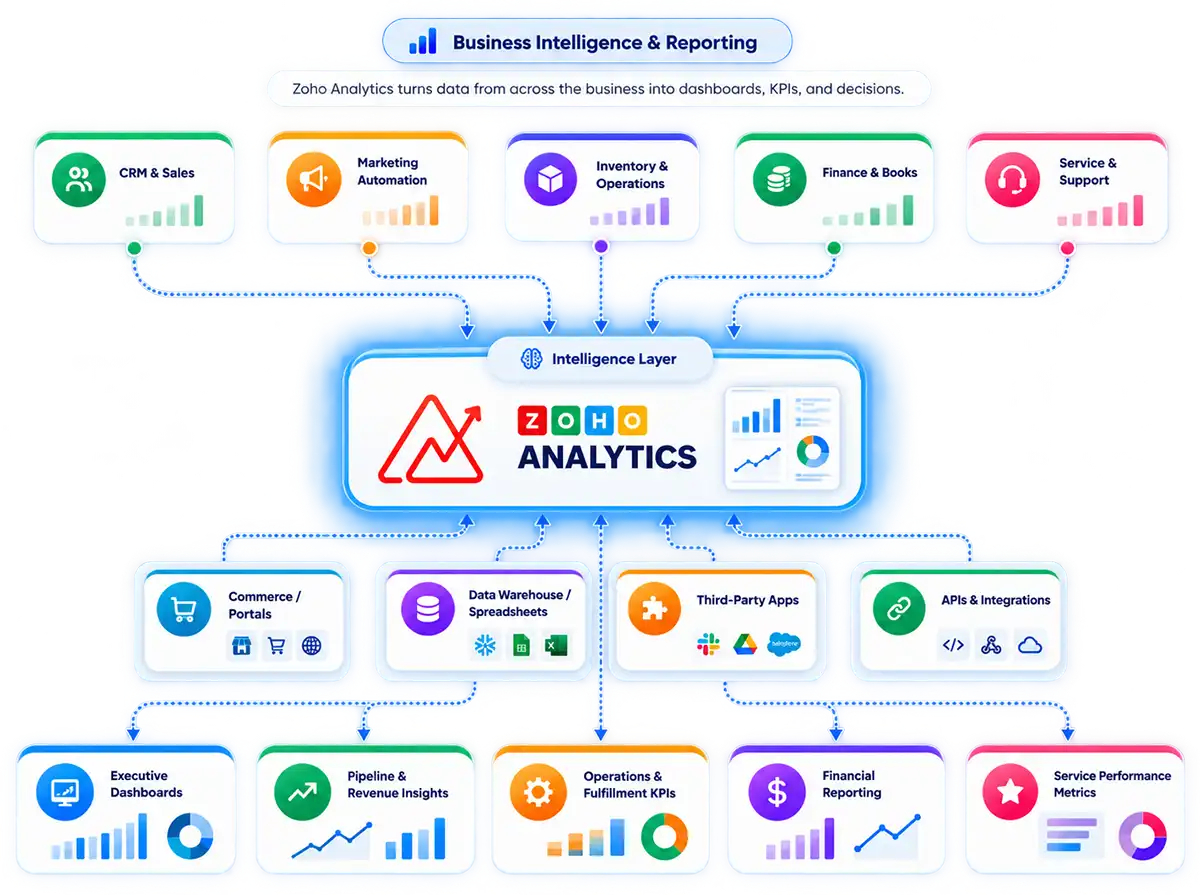
CodeStringers implements and integrates Zoho Analytics as part of broader digital enablement solutions built around your users, decisions, KPIs, and business outcomes. We connect Analytics to CRM, finance, inventory, service, marketing, external applications, databases, spreadsheets, and custom data sources so leaders and teams can work from one trusted view of the business.
 Zoho AuthorizedConsulting Partner
 Zoho and the Zoho logo are registered trademarks of Zoho Corporation.
A technically correct analytics implementation can still fail if the numbers are inconsistent, definitions differ across departments, source systems are not synchronized, or dashboards answer questions nobody actually needs to ask. The charts may look polished while employees still export data, reconcile spreadsheets, debate which number is right, and make decisions from partial information.
The result is familiar: multiple versions of the truth, manual reporting cycles, delayed insight, dashboards nobody uses, metrics without context, and leadership meetings spent reconciling numbers instead of acting on them.
The problem usually is not whether Zoho Analytics works. It is whether the data and reporting environment was designed around the decisions the organization actually needs to make.
Sales, finance, operations, and service report different answers to what should be the same business question.
Teams export CSVs, merge spreadsheets, and rebuild recurring reports by hand.
Important context is trapped in separate applications, databases, files, and external platforms.
Reports show activity but do not make it clear what changed, why it matters, or what action should follow.
Users stop relying on analytics when data quality, metric definitions, or refresh timing cannot be trusted.
The strongest analytics solutions begin with real users, real decisions, and a shared definition of what success means. Then we design the data model, reporting, and workflows needed to support them.
Executives, sales leaders, operations managers, finance, marketing, service, analysts, and frontline teams.
What each persona needs to know, how frequently they need to know it, and what decision follows.
The metrics, dimensions, business rules, ownership, and definitions required to produce a trusted answer.
Sources, pipelines, transformations, models, calculations, dashboards, permissions, alerts, and delivery.
Faster decisions, fewer reporting cycles, better accountability, earlier detection of issues, and more confident action.
Zoho Analytics is the platform. Better decisions are the goal.
Application expertise still matters. We configure Zoho Analytics deeply so the reporting layer reflects your business logic, connects the right sources, and produces information people can trust and use.
Connect Zoho applications, business apps, databases, cloud services, files, feeds, APIs, and other sources with appropriate refresh schedules.
Clean, standardize, transform, enrich, merge, and validate incoming data before it reaches reporting.
Relate data across systems, define joins and relationships, and create shared models that support cross-functional reporting.
Build formulas, aggregate logic, query tables, business rules, and reusable calculations for consistent KPIs.
Create executive, departmental, operational, financial, customer, and role-specific dashboards around decisions and outcomes.
Build charts, pivot views, summary reports, drill-downs, filters, geographic views, and detail reports for analysis.
Use Ask Zia and AI-assisted insights to help users explore data, create visualizations, and investigate trends with natural-language questions.
Surface thresholds, anomalies, trends, and forward-looking indicators so teams can act before problems become reports.
Control who can see what, distribute reports, embed analytics into portals or applications, and deliver role-appropriate views.
Manage workspaces, users, refreshes, integrations, APIs, data ownership, metric governance, and the operating practices required for long-term trust.
Zoho Analytics can become the shared intelligence layer across sales, finance, operations, marketing, service, and leadership. But the value does not come from putting every number on one screen. It comes from connecting the right data so people can understand what happened, why it happened, what is likely to happen next, and what action should follow.
A revenue decision may combine pipeline from CRM, orders and inventory from Inventory, invoices and margin from Books, campaign data from Marketing Automation, service history from Desk, website activity, and external market or industry data. None of those applications alone can provide the complete answer.
We design the question and decision workflow first, then connect and model the data required to answer it consistently.
The dashboard is not the destination. The goal is a trusted decision process supported by connected data.
To leadership, this should feel like one business question—even when the answer depends on data from multiple applications, departments, and systems.
Leadership needs to know which products, channels, customers, or regions are actually driving profitable growth—not just top-line revenue.
CRM contributes pipeline and wins; marketing contributes acquisition and campaign data; Inventory contributes orders, products, stock, and fulfillment.
Books contributes invoices, payments, costs, receivables, and other financial measures required to understand realized revenue and margin.
Analytics relates the sources, standardizes definitions, applies business rules, and produces shared metrics everyone can use.
Dashboards show revenue, margin, conversion, customer, channel, inventory, and trend data with filters and drill-downs for investigation.
Leadership changes pricing, spend, inventory, staffing, or sales focus; refreshed data shows whether the decision produced the intended result.
The executive sees one answer. The business should not have to reconcile six systems to produce it.
We do more than build dashboards. We connect, model, govern, extend, and operate the broader data environment the business depends on.
Deep Zoho Analytics setup aligned to your users, decisions, KPIs, data models, dashboards, permissions, and governance.
Connect Analytics to Zoho applications, databases, cloud services, web platforms, industry systems, spreadsheets, APIs, and other sources.
Use APIs, custom data pipelines, middleware, embedded analytics, Creator, custom software, and external services where packaged connectors stop.
Monitor refreshes, resolve data issues, maintain models, support users, improve dashboards, and evolve reporting as the business changes.
Use Analytics as the intelligence layer inside broader solutions where insight triggers better workflows, automation, and operating decisions.
Zoho Analytics provides a strong business-intelligence foundation. The complete solution may also require other Zoho applications, external systems, databases, data services, and purpose-built software to create the decision environment your organization needs.
Analytics | CRM | Books | Inventory | Desk | Marketing Automation | Projects | People | Creator | Flow | Other Zoho Applications.
ERP systems | ecommerce platforms | ad platforms | databases | cloud warehouses | spreadsheets | industry systems | financial platforms | third-party data.
Data pipelines | APIs | middleware | embedded dashboards | custom portals | operational interfaces | AI services | specialized business logic.
A connected environment where data, workflows, applications and people work together so insight becomes action — not another report.
We help mission-critical industries work smarter, scale faster, and deliver better outcomes.
Marketing run as one governed system, from theme to lead.
Raise the ERP campaign to 55 a day; the leads are converting.
Budget proposal posted with the cap check. Your 1 applies it and I read it back.
From purchase order to margin by channel, one plant floor in chat.
Listings, deals with two sides, letters of intent and splits, from one message.
Referral to billing packet with identities masked by rule.
Tickets answered from knowledge, articles written as you solve, renewals seen early.
The operating model first, then one connected system on the platforms you already run.
The common denominator isn’t industries. It’s operational complexity.
End-to-end services that ensure your Zoho Analytics environment is designed, implemented, integrated, governed, and optimized as part of the broader business solution.
Map users, decisions, KPIs, definitions, reporting cadence, data ownership, source systems, and desired business outcomes.
Configure workspaces, source connections, data models, formulas, reports, dashboards, permissions, sharing, and administration.
Connect Zoho and non-Zoho sources; automate imports and refreshes; create reliable data flows across applications, databases, files, and APIs.
Clean, standardize, blend, relate, transform, validate, and structure data so reports use consistent definitions and trusted logic.
Design executive, operational, sales, marketing, financial, service, and industry-specific dashboards around real decision workflows.
Configure Zia-assisted analysis, exception monitoring, alerts, forecasting, and other advanced capabilities where they improve decision-making.
Embed analytics into portals or applications and build APIs, middleware, custom connectors, data services, or specialized user experiences.
Monitor syncs, support users, maintain data models, govern KPIs, troubleshoot issues, improve dashboards, and evolve the environment over time.
We help determine whether Zoho Analytics is the right intelligence layer—and where another BI platform, data warehouse, specialized analytics product, or existing enterprise standard should play a role.
Your business is unique. Your solution should be too. Not sure? We will evaluate the decisions, data, users, and existing technology first and recommend the right role for Zoho Analytics—even if another platform should remain part of the architecture.
Zoho Analytics is a strong fit for many small and mid-sized organizations that need to combine data from multiple business systems, create governed dashboards, support self-service reporting, and connect closely with the Zoho ecosystem without adopting a heavyweight enterprise BI stack. The right answer depends on your existing technology, data volume, analytics maturity, governance requirements, and the kinds of decisions you need the platform to support.
Our services can include analytics strategy, decision and KPI mapping, Zoho Analytics implementation, source-system integration, data preparation, modeling, dashboard and report development, Zia and AI-assisted analytics, alerts, permissions, embedded analytics, custom integration, training, administration, governance, and ongoing optimization.
Yes. One of its strongest use cases is combining data from applications such as Zoho CRM, Books, Inventory, Desk, Marketing Automation, Projects, and other systems so the business can analyze a complete process rather than separate application reports.
Yes. Zoho Analytics supports a broad range of data sources, including business applications, databases, files, cloud services, and APIs. CodeStringers can also build custom integration or data-pipeline components when a standard connector does not meet the requirement.
Yes. Spreadsheet and file-based data can be incorporated, which is useful during migrations or when an important dataset does not yet live in a formal system. We also evaluate whether that file should remain part of the long-term architecture or whether it should move to a more governed source of truth.
We treat metric definitions, source ownership, transformations, refresh timing, relationships, and validation as part of the implementation—not as cleanup after dashboards are built. We reconcile key measures against source systems and document the business logic so users understand what each KPI means and where it comes from.
Yes. Zoho Analytics includes Zia-powered capabilities for conversational analysis, visualization assistance, insights, and other AI-supported analytics. We use AI where it helps users explore and understand trusted data; it does not replace the need for a sound data model and agreed business definitions.
Sometimes. For Zoho-centered and many mid-market environments, Zoho Analytics can provide the data integration, visualization, dashboard, self-service, and AI capabilities the organization needs at a practical cost. Organizations already standardized on Power BI or Tableau—or those with specialized enterprise analytics requirements—may be better served by keeping those platforms. We evaluate fit rather than forcing a migration.
Not necessarily. Many implementations can connect directly to business applications, databases, and files. A warehouse may make sense when data volume, history, transformation complexity, governance, performance, or enterprise architecture requires it. We design the data architecture around the use case rather than assuming every analytics project needs the same stack.
Yes. We can assess source connections, sync reliability, data preparation, relationships, calculated metrics, dashboards, permissions, adoption, refresh performance, and KPI definitions. We then redesign the parts that are creating unreliable numbers, manual reporting, poor performance, or low user trust.
Yes. Analytics can be shared or embedded in broader digital experiences, subject to the platform, licensing, security, and implementation requirements. CodeStringers can also build the surrounding portal, application, APIs, or integration layer when the reporting experience needs to be part of a larger solution.
Yes. We provide ongoing administration, data-source monitoring, model maintenance, dashboard changes, user support, metric governance, troubleshooting, training, and continuous optimization as the business, systems, and reporting needs evolve.
A dashboard consultant may focus on charts and reports. CodeStringers combines analytics expertise with systems integration, software development, data architecture, workflow design, and ongoing technical operations. We treat Analytics as the intelligence layer of a larger digital enablement solution, with the goal of improving decisions and operations—not simply producing more dashboards.
Built-in reports show data from one application. They are quick and answer departmental questions well. Zoho Analytics pulls data from several applications and outside sources into one workspace, relates them, and applies shared formulas, so a dashboard can show pipeline, orders, invoices and support tickets for the same customer side by side. The time to move to Analytics is when a question needs two systems, or when two teams report different numbers for the same thing.
Zoho applications connect through built-in connectors with scheduled sync. Beyond those, Zoho Analytics imports from relational databases, cloud data warehouses, cloud storage, spreadsheets and uploaded files, web feeds, and any system with an API through the import API or a middleware tool. Each source gets its own refresh schedule. The design question is which system owns each record, so that a customer or an order is counted once in the combined model.
Each data source has its own sync schedule, set at intervals that depend on the connector and the plan, from several times a day to weekly. Imports through the API can run as often as the sending system calls them. Zoho Analytics is not a live operational screen; an agent or a warehouse user needs the source application for that. Dashboards for daily and weekly decisions work well, and the refresh time is shown on the view so people know what they are reading.
Yes. Views can be shared with named users, published to a link with or without a password, embedded in a portal or internal application, and scheduled as emailed exports. Permissions apply at the workspace, view and row level, so a customer or a partner sees only its own records. Embedded analytics is a common fit for a customer portal where the business wants to show order history or service metrics without giving access to the source systems.
Write the definition down before building anything: what counts, what is excluded, which system supplies the number, and who owns a change to it. Then build the calculation once in Zoho Analytics as a shared formula or query table and point every dashboard at it, instead of letting each report recompute it. A short metric dictionary kept next to the workspace settles most arguments, because the disagreement is usually about the definition, not the data.
We write your systems’ configuration as code and let AI apply it: fields, picklists, layouts, workflow rules, integrations, read back and verified after every step, so a build that took weeks of clicking takes days.
Because the work is programmatic, we quote the outcome, not the hours. The estimate is guaranteed and discovery is no-risk.
Our own Zoho CRM rebuild in October 2026: 21 shared picklists, 3 modules, 88 fields, 7 layouts, 23 workflow rules and 16 actions, built in the sandbox through code in 22 verified runs, every step read back.
The same tools that configure your systems today are what run our agentic solutions tomorrow: one surface over the systems you already own. See the agentic solutions
Where we're not the right answer
Your organization is deeply standardized on Power BI, Tableau, Looker, or another BI platform that already meets the business need. You require a highly specialized enterprise data-science or big-data architecture that belongs in a different analytics stack.
We will start with the people, decisions, KPIs, source systems, and data your business depends on, then show you where Zoho Analytics fits and what the complete intelligence layer needs to turn fragmented data into trusted action.