
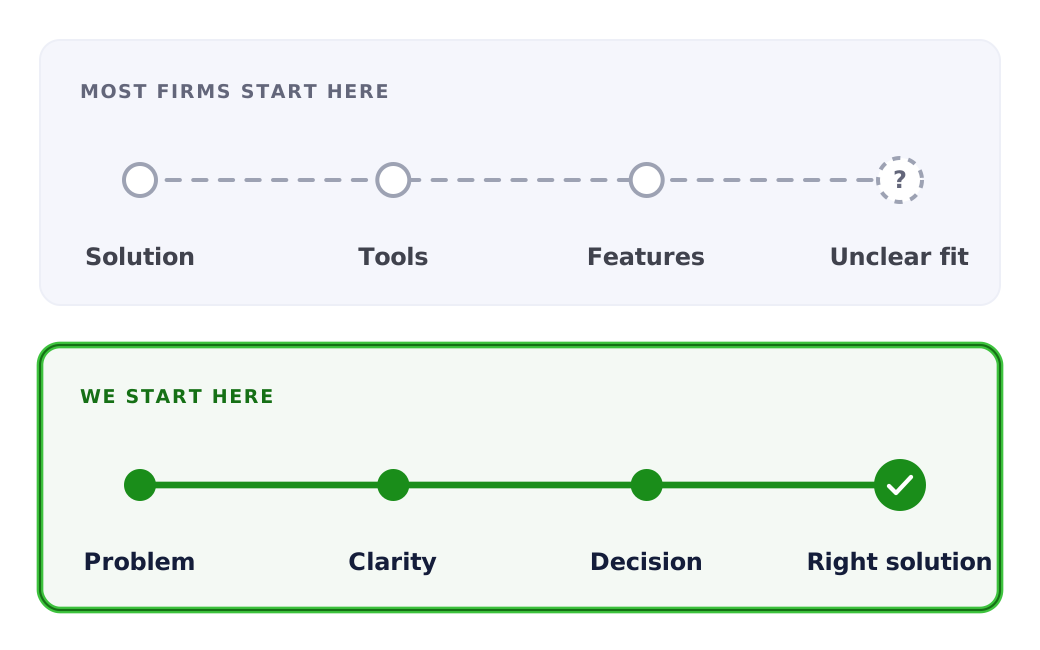
Expectations are unclear.
Reduce uncertainty early, before commitment.
Most technology engagements fail long before anything is built — because expectations are unclear, decisions are rushed, ownership is fragmented, and everyone assumes someone else is “handling that part.” We designed our process to avoid those traps.
Three traps we designed our process to avoid, and the move we make in each case.
Reduce uncertainty early, before commitment.
Senior leadership in the room, deciding deliberately.
One accountable team — through launch and after.
We start by understanding how your business actually operates, where things are breaking down, and what matters most right now. Only then do we decide what to build.
Good solutions come after clarity — not before.
Designed for SMBs and startups with real operations, owners who are experts in their business, and companies that want fewer vendors, not more.
Senior technology ownership in the room, part-time — so the right decisions get made before they’re expensive to unwind.
Connect the tools you already run so data flows cleanly and busywork gets automated.
Built when nothing off the shelf fits — and not before. All under one accountable partner.
Clients tell us working with CodeStringers feels different. It’s not accidental — it’s how we structure the work.
You’re not expected to have all the answers. Everything gets explained in business terms — not jargon.
Choices are made collaboratively, with the tradeoffs visible — not handed down after the fact.
Less scrambling, fewer surprises. Someone is actually responsible for the outcome through launch & after.
Every situation is different, but most engagements follow the same general flow. You’re never handed off to “the team” and left to figure things out.
Reduce uncertainty before committing to scope or cost.
Align on scope, priorities, and ownership before work starts.
Systems, software, and automation delivered under accountable leadership.
Adapt as the business changes — we don’t disappear after launch.
Business application platforms are the foundation. Our solutions are built user experience and workflow first, features second: a CRM is a CRM, and the platform you already run is the one we build on. Zoho is our partner; the rest we support through their published APIs, with the keys coming from your own instance in production. A platform we have not connected yet is a small project for the first customer who asks.



























Whether this approach fits your business.
We help businesses make better technology decisions.
One owner across strategy, systems & software.
Discovery first, to understand how the business operates and where it breaks before any tool is chosen. Engagement setup, to agree scope, priorities and who owns what. Execution, where systems, integrations and software are delivered in increments with senior leadership deciding, not just advising. Iteration after launch, because the business keeps changing and the software has to keep matching it. The order matters: solutions chosen before clarity are the ones that get rebuilt.
Discovery is short and focused: enough sessions to map the workflows, the systems they touch and the spreadsheets holding things together, then to diagnose where work goes manual and data drifts. It produces two or three credible options with a read on cost, complexity and risk for each, not a specification. Larger operations with more systems take longer to map, but the aim is signal rather than slides, so it is measured in days and weeks, not months.
One named person is responsible for the outcome across strategy, systems and software, through launch and after. You are not handed from a salesperson to a project manager to a support queue. Decisions are made with you, with the trade-offs visible, and the same team that designed the integration keeps running it. The practical effect is that when something breaks between two systems, nobody has to work out whose problem it is.
An owner or senior leader who can decide, and the people who actually run the workflows being changed, because they know where the real process differs from the documented one. Nobody is expected to have technical answers; everything is explained in business terms. Time commitment is heaviest in discovery and at decision points, lighter during execution. Engagements stall when the decision-maker delegates attendance, so that seat matters more than any other.
The engagement does not end at go-live. Most technology failures appear afterwards, when a connected system changes, a workflow drifts or a team finds a gap, so the work continues as iteration: adjusting scope as the business changes, fixing what breaks and adding what proves necessary. For managed solutions that is a subscription with operations and advisory built in; for services work it is a continuing relationship rather than a handover to a help desk.
Only when nothing off the shelf fits, and not before. The default is to configure and connect the platforms already in place, because that is cheaper to build and cheaper to keep. Custom software earns its place when a process is genuinely particular to the business, when a packaged tool gets eighty percent of the way and the last twenty is what matters, or when the integration itself needs logic no connector provides.
A short, practical conversation that helps you understand whether your operational reality is the kind we’re built for — without committing to anything big.