Monolithic vs Microservices Architecture: How to Choose.
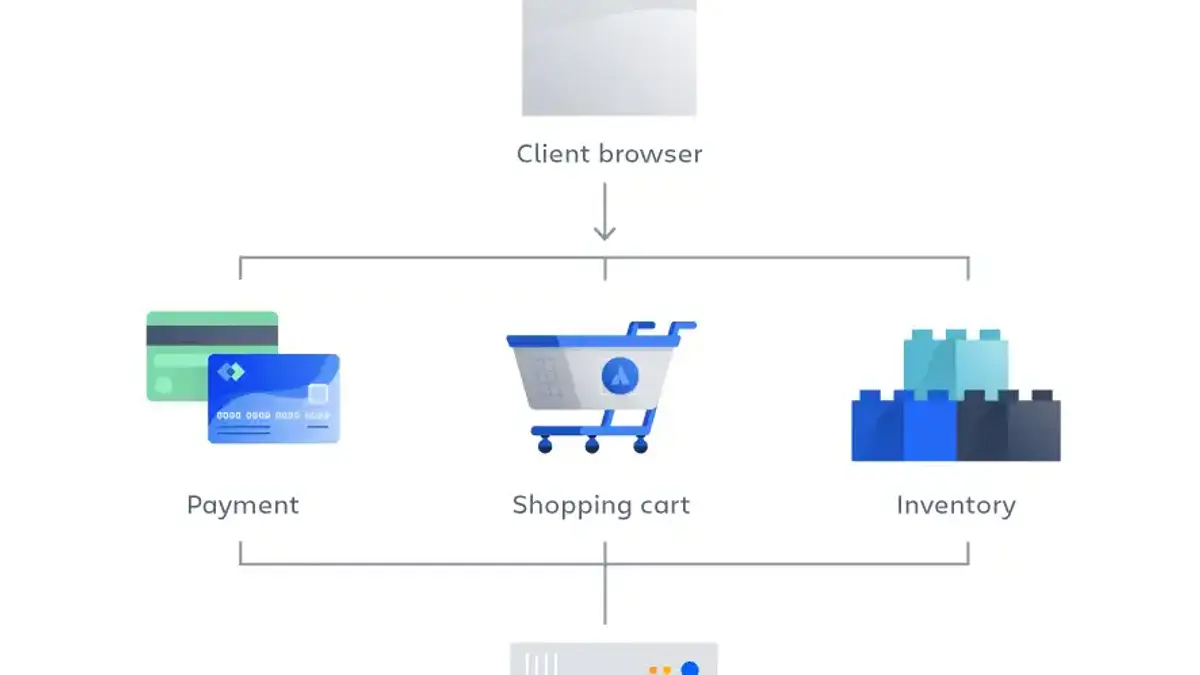
Software architecture plays a crucial role in determining the scalability, maintainability, and efficiency of an application. Over the years, two primary architectural patterns have dominated the industry: Monolithic and Microservices.
As businesses continue to expand and technology evolves, choosing the right architecture in 2025 is more important than ever. Many startups and enterprises are at a crossroads, wondering whether they should stick with the traditional Monolithic architecture or transition to a Microservices-based system.
A Monolithic architecture is a traditional software design in which all components of an application—user interface (UI), business logic, and database interactions—are built as a single, unified system. The entire application is packaged, deployed, and maintained as a single unit.
In this architecture, all functionality runs within the same process and codebase, meaning that if developers want to update or modify any part of the system, they must redeploy the entire application.
For example, consider an e-commerce platform. In a Monolithic design, the user authentication, product catalog, shopping cart, payment processing, and order management all exist within the same application. Any change to one feature—such as updating the payment gateway—requires modifying and redeploying the entire system.

Monolithic architecture is commonly used for small to mid-sized applications due to its simplicity, ease of development, and straightforward deployment. It was also used in the vast majority of applications up until the early 2010s.
Monolithic architecture is used in approximately 25% of today’s applications due to its simplicity in development, deployment, and maintenance. Here are the key advantages:
Easy Deployment: Since the entire application is packaged as a single executable file or folder, deployment is straightforward. Unlike Microservices, which require coordinating multiple services, Monolithic applications can be deployed with minimal effort.
Simplified Development: With everything in a single codebase, development is more manageable. Teams don’t need to handle complex API communications or distributed data storage, making collaboration easier.
Better Performance: A Monolithic application runs as a single process, reducing inter-service communication overhead. A single API can often perform the same functions that would require multiple API calls in a Microservices-based system, leading to faster execution.
Simplified Testing: Since all components exist within one unit, end-to-end testing is faster and requires fewer testing frameworks compared to distributed Microservices, which need extensive integration testing.
Easier Debugging: With all the code in one place, developers can trace requests and identify issues more quickly without navigating multiple logs and services, speeding up issue resolution.
While Monolithic architecture is simple to start with, it comes with several challenges as applications grow in size and complexity.
Slower Development Speed: A large codebase makes development more complex and slower, limiting teams' ability to work in parallel.
Limited Scalability: The entire application must scale as a whole, making resource allocation inefficient compared to Microservices.
Reliability Issues: A failure in any module can impact the entire system, reducing overall availability.
Technology Constraints: Any framework or language change affects the entire system, making upgrades costly and time-consuming.
Lack of Flexibility: Monolithic applications are locked into their existing technology stack, making modernization difficult.
Challenging Deployment: Even small updates require redeploying the entire application, slowing down releases and increasing risks.
The final two disadvantages are the most significant because they hinder companies in their abilities to adapt to today’s quickly changing tech environment.
Microservices architecture is a modern software design pattern that structures an application as a collection of small, independent services that communicate through APIs. Unlike Monolithic applications, where all functionalities are tightly integrated into a single codebase, Microservices allow each service to operate independently, making the system more modular, scalable, and resilient.

Each microservice is designed to handle a specific business function and can be developed, deployed, and scaled separately. For example, an e-commerce platform built with Microservices might have distinct services for user authentication, product catalog, payment processing, and order management. These services interact with each other through lightweight RESTful APIs, gRPC, or message brokers like Kafka or RabbitMQ.
Microservices architecture is now used in the majority of new software applications due to its scalability, flexibility, and resilience. Unlike Monolithic applications, where all functionalities are tightly coupled, Microservices allow teams to build and maintain independent services that work together seamlessly. Here are the key advantages:
Scalability and Efficiency: Each service can be scaled independently, allowing businesses to allocate resources where needed. For instance, an e-commerce platform can scale checkout and payment services separately during peak sales without affecting other components.
Faster Development and Deployment: Teams can develop and deploy services independently, enabling continuous integration and deployment (CI/CD). This speeds up time-to-market and reduces downtime.
Technology Flexibility: Unlike Monolithic applications, Microservices allow developers to choose the best tools and frameworks for each service. A recommendation engine may use Python, while a video processing service runs on Go for efficiency.
Improved Fault Isolation: A failure in one microservice does not bring down the entire system. If a payment gateway fails, users can still browse products and add them to their cart without disruption.
Easier Maintenance and Debugging: Since services are modular and smaller, developers can debug and update specific services without affecting the entire application, making maintenance more manageable.
Better Performance with Distributed Processing: Services can run across multiple servers or regions, reducing latency and preventing bottlenecks. This is especially useful for applications like ride-hailing or real-time streaming services.
Security and Compliance: Sensitive services, such as payment processing, can be isolated and secured separately, reducing risk and improving compliance with regulations like PCI-DSS.
Enhanced Monitoring and Observability: Tools like Prometheus, Grafana, and Datadog help businesses track service health, detect issues, and optimize performance in real-time.
While Microservices offer scalability, flexibility, and fault isolation, they also introduce new challenges that can complicate development, deployment, and management. Below are the key disadvantages of Microservices architecture:
Increased Complexity: Unlike Monolithic applications, Microservices require managing multiple independent services, each with its own codebase, database, and dependencies. This demands advanced tools for service discovery, API management, and configuration handling.
Difficult Debugging and Troubleshooting: Since a single request may pass through multiple services, tracking down issues becomes more complex. Debugging requires centralized logging and distributed tracing to follow request flows across services.
Network Latency and Communication Overhead: Microservices rely on API calls for communication, introducing network latency and failure risks. To mitigate this, businesses must implement caching, message queues, and circuit breakers to handle failures efficiently.
Data Consistency Challenges: Each microservice typically manages its own database, making synchronization and consistency more complex. Businesses must use event-driven architectures, distributed transactions, or eventual consistency models to manage data across services.
Higher Infrastructure and Maintenance Costs: Running multiple services requires dedicated databases, load balancers, and orchestration tools like Kubernetes, leading to higher cloud and operational costs. Small businesses may struggle with these overheads.
Complex Deployments: Unlike Monolithic applications, where a single deployment suffices, Microservices require independent deployment pipelines, version control, and rolling updates to ensure compatibility between services. Without robust CI/CD, deployment can become a bottleneck.
Security Risks: With multiple exposed APIs, Microservices increase the attack surface. Ensuring secure authentication, API encryption, and access controls is critical to preventing breaches.

Below is a comparison table between Monolithic and Microservices architecture.
The best choice depends on your business needs, project size, and technical expertise:
Choose Monolithic if:
You are building a small to medium-sized application with a limited budget.
Your team is small, and you want to minimize operational complexity.
You need to launch quickly, such as for an MVP (Minimum Viable Product).
Choose Microservices if:
You need high scalability and plan for long-term growth.
Your application requires frequent updates and independent deployments.
You have a strong DevOps team to manage service orchestration, security, and monitoring.
There is no one-size-fits-all solution when choosing between Monolithic and Microservices architectures. The decision should be based on business needs, team expertise, and scalability requirements.
Startups & small teams should consider Monolithic to accelerate development.
Enterprises with complex applications should adopt Microservices for better scalability and agility.
2025 brings new opportunities, making Microservices more accessible with advanced DevOps tools, but Monolithic architecture still has its place in specific use cases.
Whether you choose Monolithic or Microservices, adopting the right tools and methodologies will be the key to success in 2025!
In a no-risk discovery we look at your CRM, finance and operations systems and who owns each part, and show what a connected system would do differently. You pay only if you proceed. Or see how we approach it.
More on the same problem:
Behavioral Health CRM: What Breaks Between Intake, Clinical and Billing. (article)
System of Record vs Source of Truth: The Integration Decision You Make Once (article)
Almost always a monolith. A startup does not yet know where its load, its team boundaries or its product lines will fall, and microservices force those decisions early and make them expensive to reverse. A well-structured monolith, with clear module boundaries and a single deployable, lets a small team ship fast and learn. Services can be split out later from the parts that prove to need independent scaling or ownership, which is the path most successful products took.
A modular monolith is a single deployable application whose code is organized into modules with explicit boundaries: each module owns its data and exposes a defined interface, and other modules call it only through that interface. It keeps the simple deployment, testing and debugging of a monolith while avoiding the tangled dependencies that make monoliths hard to change. It is also the best preparation for microservices, since a module with clean edges can be extracted as a service when needed.
Incrementally, using what is often called the strangler pattern. Pick one capability with a clear boundary and a reason to be separate, such as heavy load or a distinct team, build it as a service, route traffic to it, and remove the old code once it is stable. Repeat for the next capability. Tackle the data split with each service, since shared databases keep services coupled. A full rewrite into services at once fails far more often than it succeeds.
Usually yes, at least at first. Each service needs its own deployment pipeline, monitoring, logging and often its own database, and the network calls between services add latency and infrastructure. The team also needs skills in orchestration, service discovery and distributed tracing. The cost is justified when it buys something the business needs, such as scaling one hot component independently or letting several teams release without coordinating. For a single small team it rarely pays back.
A common rule of thumb is that microservices start to pay off when several teams, not several developers, need to work on the same product without blocking each other, which usually means somewhere beyond twenty to thirty engineers. Below that, a single team can coordinate changes inside one codebase faster than it can manage a fleet of services. Team structure is a better guide than user count, because services mirror the organization that builds them.
Yes, further than many teams assume. A monolith scales horizontally by running more copies behind a load balancer, and vertically by using a larger server, and most business applications never exceed what that supports. What a monolith cannot do is scale one part independently of the rest, so if a single feature, such as report generation or image processing, dominates the load, that is the component to extract first. Scaling limits are reached by the database more often than by the application.
"Something isn't working." "We're outgrowing our tools." "We're afraid to make the wrong move." No-Risk Discovery is a short, practical conversation that gets you clarity before you commit to anything big. We'll tell you if we're a fit. If we're not, we'll tell you that too.
Say who you are and ask. A person replies within one business day.