Off the Shelf vs Custom Software: What a Growing Business Should Weigh.
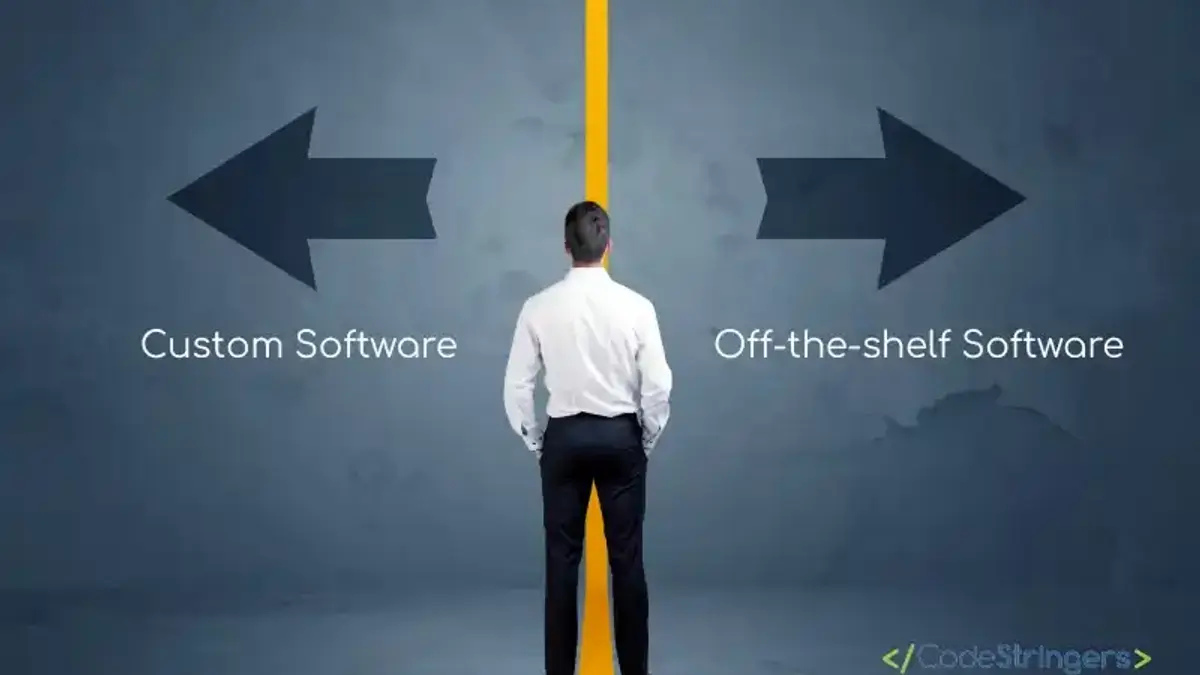
If you’re starting a business in the 21st century, you are almost certainly going to need software solutions to run your business. Even the lowest technology businesses will need websites, accounting systems, billing systems, etc. Consequently, one of the first questions you’ll need to ask yourself is, “Do I need to build custom software or should I license something off the shelf?”
We hear this question all the time at CodeStringers, particularly from startups. The company has a business idea with specific technology requirements, but the founders don’t know the best way to meet them.
The answer depends on your answers to a few key questions.
A business school professor once told our class that business was essential, “one big make-vs-buy decision”. For those of you who don’t know, “make vs. buy” is a fancy way of saying that you don’t have to do everything yourself. As an entrepreneur, how you spend your time is the most important decision you have to make every day. If you spend all day fetching office supplies and configuring email servers, you won’t have time to develop a competitive product or solicit business. Therefore, you should “buy,” pay someone else to do, anything that your company isn’t best at. So how does this apply to technology decisions?
You may want to read: How much does custom software development cost?
As an example, let’s pretend that you’re starting a business that makes knitted hats. What do you think your hat clients are going to care about— the digital store’s e-commerce solution? or the quality and craftsmanship of the hats themselves? On the other hand, say that you’re building a digital community that brings together knitters with high-end clients looking for bespoke hats. How would that change your answer?
In case it’s not obvious, the former example would be better suited to buying off the shelf, whereas the latter might require a custom solution. In the second example, technology is central to the business’s value proposition, whereas in the first, it is not.
Yes, this question looks like common sense, but entrepreneurs often get the answer wrong.
In many cases, the answer is a most certain “yes”. For example, if you’re manufacturing physical goods, selling them online, and shipping them to your customers, 99.9% of the time, you can use an existing e-commerce platform like Shopify. This also applies to companies needing a marketing website. You can use Wix or Squarespace and save yourself a lot of time, money, and headache.
On the other hand, there are situations where no solution exists. E.g., if you wanted to start a business that delivers pizza with drones, you’re going to have a hard time managing that business with an off-the-shelf solution.
But sometimes the answer lies in the middle. Sometimes you can use off-the-shelf software such as Zoho for the “solved problems” (i.e., where there are already existing, well-functioning solutions), and integrate it with some new customizations.
If you’re hoping/planning to, ultimately, sell the business, then you’re going to want to make decisions that ultimately increase the purchase price. Theoretically, a potential acquirer will value your company based on what similar businesses have sold for in the past. The measurement they typically use is “Price Earnings Ratio” or “P/E Ratio”, which means that you take the company’s total earnings (profit) and multiply it by this ratio to get your price. According to a recent study by NYU Business School, application software companies have a P/E ratio of 130, compared with the industry average of 99. This means that you can expect to sell your company for 30% more if you’re considered a software company.
If you use off-the-shelf software, you certainly will not be considered a software company, whereas if you build a custom solution, you might be.
Ultimately, this decision is up to you as an entrepreneur, and there isn’t necessarily a “right answer”. However, hopefully the above questions will help you navigate this difficult decision. If you have any questions or would like to discuss them further, please drop us a message or give us a call.
In a no-risk discovery we look at your CRM, finance and operations systems and who owns each part, and show what a connected system would do differently. You pay only if you proceed. Or see how we approach it.
More on the same problem:
Custom Software vs Off the Shelf: How to Actually Decide (article)
Custom Business Broker Software: Who Needs It and Who Should Just Buy (article)
From Chaos to Clarity: Why Every Growing Business Needs a Single Source of Truth (video)
Any product built once and licensed to many customers: an e-commerce platform, a website builder, an accounting package, a CRM or a help desk. You configure settings and adapt your process to the product's model. The vendor owns the code and the roadmap, you pay a subscription or licence, and upgrades arrive for everyone at once. Custom software is the opposite: built for one organization, owned by it, and changed on its schedule.
Ask what the customer is paying for. If the product is a physical good or a service and the software only takes orders or sends invoices, technology is ancillary and should be bought. If the software is the product, or the way it works is the reason customers choose you, technology is core and the part that differentiates you is worth building. Most businesses have a small core and a large ancillary layer.
It can, when the software is a real asset: owned outright, documented, maintained and central to how the business earns revenue. Buyers value proprietary technology they can keep running without the founders. A custom build that duplicates a product anyone can rent adds little, and may be a liability if nobody else can support it. The question is whether the code is part of what the acquirer is buying.
Per-seat pricing rises as you hire, the feature you need may never ship, and your data and process logic live in the vendor's schema, which makes leaving a migration project. The product also serves thousands of companies, so it cannot model a process that is unusual, and your team pays for the gap in workarounds. None of these matter for a generic function, and all of them matter for a core one.
Yes, and the combination is the usual answer. A packaged product handles the solved problems and exposes an interface, and a small custom component handles the logic the product cannot, exchanging data with it through that interface. This keeps the build small and the subscriptions doing what they are good at. The design question is which system owns each piece of data so the two do not fight.
"Something isn't working." "We're outgrowing our tools." "We're afraid to make the wrong move." No-Risk Discovery is a short, practical conversation that gets you clarity before you commit to anything big. We'll tell you if we're a fit. If we're not, we'll tell you that too.
Say who you are and ask. A person replies within one business day.