Zoho CRM Training: How to Get Your Team to Actually Use It
Updated: 3 days ago

A manufacturer we worked with spent four months and a healthy budget standing up Zoho CRM. Clean pipeline stages, tidy custom fields, a slick dashboard for the VP of Sales. Six weeks after go-live, three of their five reps were still running deals out of a shared spreadsheet and their own inboxes. The software wasn't broken. The rollout was. Nobody had invested in Zoho CRM training, and nobody had taught the team why the CRM existed or how it fit their day — so they quietly went back to what they knew.
If you've landed here, you probably own that problem right now, or you can see it coming. The good news: the fix is mostly training and change management, not more configuration. As Zoho CRM consultants who get called in after the honeymoon ends, we spend as much time on adoption as on the build — because a CRM nobody uses is just an expensive contact list.
Zoho CRM training is the structured process of teaching each role on your team — admins, managers, and end users — how to do their real daily work inside Zoho CRM, then reinforcing it until the CRM becomes the default place work happens. Done well, it's the difference between a system of record and a system people actually trust.
Why does training matter more than the software?
Here's the uncomfortable number: the average CRM user adoption rate among sales professionals is 72%, according to G2's Winter 2025 Grid Report for CRM. That means more than one in four reps with a license aren't consistently using the tool their company pays for. And 40% of salespeople still keep customer data in spreadsheets and email, per HubSpot's 2024 State of Marketing report.
The cost of that gap is real. Nucleus Research pegs CRM returns at $8.71 for every dollar spent — but you only collect that return on the records that actually get entered. Every deal tracked in a personal spreadsheet is revenue your forecast can't see, a follow-up that falls through, and a customer history that walks out the door when the rep does.
The pattern behind low adoption is almost never "the software is too weak." It's that the rollout treated training as a one-hour demo at the end of the project. People got shown the buttons, nobody connected the buttons to their job, and within a month muscle memory won. Aberdeen Group found that high-performing sales organizations are 81% more likely to use their CRM consistently — the performance gap and the usage gap are the same gap.
A CRM you configured perfectly and trained badly will lose to a spreadsheet every time.
What does good Zoho CRM training actually cover?
Training is not a product tour. A tour teaches features; training teaches jobs to be done. The reps don't need to know every module exists — they need to know exactly how to log a call, move a deal, and find their next task without thinking about it.
Good Zoho CRM training is built around the handful of workflows each person repeats every day:
For reps: create and convert a lead, log activities, advance a deal through the pipeline, and read their own task list. That's 80% of their CRM life. If those four things are effortless, adoption follows.
For sales managers: build and read reports and dashboards, reassign records, and use the pipeline to run a real forecast conversation instead of a status meeting.
For admins: manage users, roles, and profiles, adjust fields and layouts safely, and maintain automation without breaking it.
Everything else — custom modules, blueprints, advanced analytics — is second-wave material you layer on once the core habit exists. Try to teach all of it on day one and people retain none of it.
How do you build a Zoho CRM training plan?
The teams that get adoption right treat training as a phased program, not an event. We run it in five phases, and it maps cleanly onto how people actually learn a tool they didn't ask for.
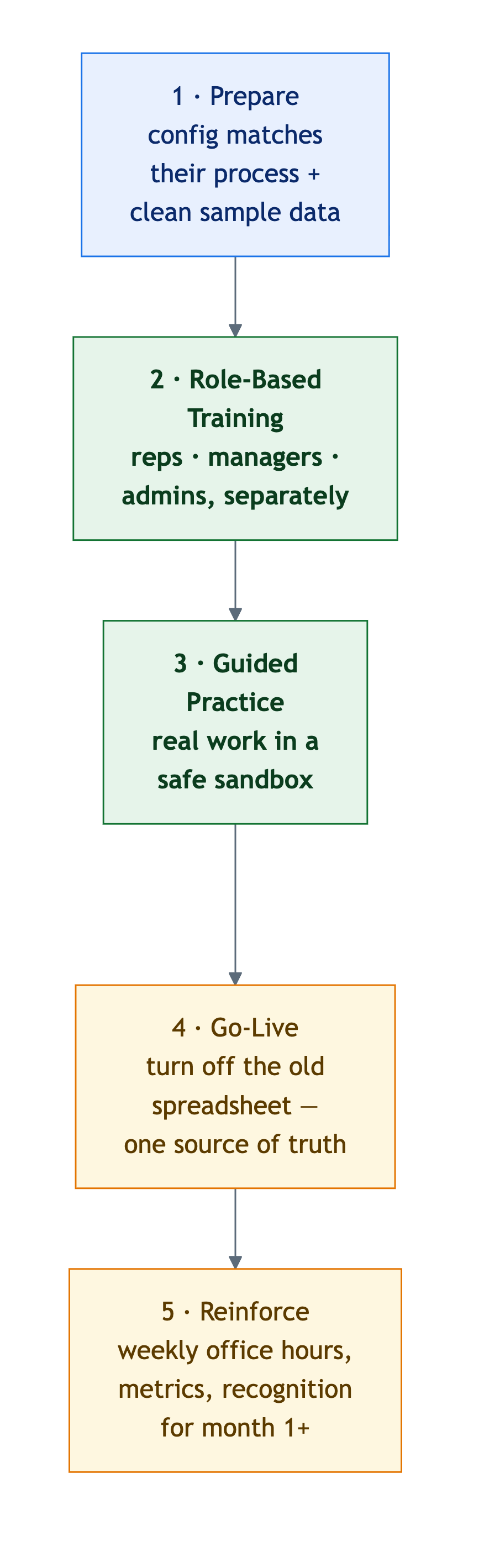
Prepare. Before you train anyone, make sure the CRM reflects their process — their pipeline stages, their field names, their language. Training on a generic default config is training people to distrust the system. This is also where you load real, clean sample data so practice feels like the real job. (Getting that data in cleanly is its own discipline — see our guide to importing data into Zoho CRM.)
Role-based training. Separate sessions for admins, managers, and reps, each focused only on that role's daily workflows. Mixed-role sessions bore the people who don't need the detail and overwhelm the ones who do.
Guided practice. Let people do their real work in a safe copy of the system while someone watches and coaches. This is where retention actually happens — not in the slides.
Go-live. Turn off the old spreadsheet. Adoption dies when the escape hatch stays open; if reps can still update the shared sheet, half of them will. Make the CRM the only place the work lives.
Reinforce. Weekly office hours, a short refresher on the one thing everyone keeps getting wrong, and public recognition for the people using it well. Habits set in the first month; reinforcement is what keeps them.
Skipping any phase shows up later as an adoption problem you'll misdiagnose as a software problem.
Role-based training: who needs to learn what?
The single highest-leverage change most teams can make is to stop training everyone on everything. Match the depth to the role:
Role | What they must master | Session length | Reinforcement |
End users (reps) | Leads, deals, activities, tasks, their own views | 60–90 min | Weekly office hours, month 1 |
Sales managers | Reports, dashboards, forecasting, record reassignment | 90 min | Biweekly report review |
Admins | Users, roles/profiles, fields/layouts, workflow rules | Half day + ongoing | Monthly admin sync |
Executives | Reading dashboards, pipeline hygiene expectations | 30 min | Quarterly |
Notice the executive row. Adoption research keeps finding executive sponsorship among the top predictors of CRM success — when leaders read the CRM's dashboards in meetings and refuse to accept numbers from anywhere else, reps update their records. Culture beats training slides.
Which native Zoho tools make training stick?
Zoho CRM ships with features built specifically to lower the training burden. Most rollouts ignore them and then wonder why adoption lagged. Use them:
Sandbox. Zoho CRM's sandbox is a full copy of your setup where people can practice — create junk deals, delete them, break things — with zero risk to live data. It's the single best training tool in the product and it's included on paid editions.
Seed / sample data. Populate the practice environment with records that look like real accounts so training exercises feel like the actual job, not a toy.
Guided onboarding and setup checklists. Zoho's in-app setup guidance plus your own Zoho CRM user onboarding checklist give every new hire a repeatable first-day path instead of a shrug and a login.
Gamification (Zoho Motivator). Turning data-entry hygiene into a visible leaderboard sounds gimmicky until you watch a competitive sales floor start logging every call to climb it.
Zoho Learn / knowledge base. A short library of two-minute how-to clips for your exact configuration means the answer to "how do I convert a lead again?" is a search, not a Slack interruption.
None of these replaces a human walking the team through their workflows. They make the human's job stick.
How do you measure whether training worked?
You can't manage adoption you don't measure. Set a baseline in week one and track a few honest metrics rather than a vanity dashboard:
Daily active users — what share of licensed users log in and do something most days. Aim for 70%+ as a floor for healthy ROI.
Records created per rep per week — are deals and activities actually being logged, or is the pipeline a ghost town?
Data completeness — the percentage of required fields filled on key records. Empty fields are a training signal, not a discipline problem.
Report usage by managers — if managers aren't opening dashboards, reps have no reason to keep them accurate.
When a metric sags, it points at a specific gap: low logins means the CRM isn't part of the daily flow yet; empty fields mean a workflow is too fiddly and needs simplifying or re-teaching. Treat every dip as a coaching opportunity, not a scolding one. The teams that hold to solid Zoho CRM best practices and watch these numbers tend to hit real adoption inside a quarter.
What are the most common Zoho CRM training mistakes?
The failure modes are remarkably consistent across the rollouts we've rescued:
The one-and-done demo. A single group session, no practice, no follow-up. People forget 80% of it within a week.
Training on a default config. If the pipeline stages and fields don't match how the team actually sells, you're teaching them to distrust the tool.
No sandbox practice. Watching a demo isn't learning. Doing the work — safely — is.
Leaving the old system on. Two sources of truth means the CRM becomes the second-class one.
Skipping the admin. An untrained admin makes a well-meaning change that breaks automation, and the whole team loses faith in the data.
We wrote up the deeper version of this in common Zoho CRM setup mistakes — several of them are really training failures wearing a configuration costume.
When should you bring in a partner?
Plenty of small teams train themselves successfully, especially with a clean setup and Zoho's own resources. Bring in help when the stakes or the complexity climb: you're migrating from Salesforce or HubSpot and can't afford a stalled quarter, your process spans multiple apps and needs real Zoho integration work, or you've already had one failed adoption attempt and need it to work this time. This is where a business systems consultant earns their fee: a good partner doesn't just run sessions — they design the workflow automation (a topic we cover in our Zoho CRM workflow automation guide) so the CRM does more of the work for the rep, which is the most durable adoption strategy there is.
If any of that sounds like your situation, book a free Zoho consultation and we'll pressure-test your rollout plan before it hits the sales floor.
FAQ
How long does Zoho CRM training take? For a standard sales team, plan on a half day of role-based sessions plus a month of light reinforcement (weekly office hours). Admins need more — a full day up front and ongoing support as the system evolves. The training event is short; the reinforcement window is what actually builds the habit.
Can we train our team ourselves, or do we need a consultant? Small teams with a clean, simple setup can absolutely self-train using Zoho's sandbox, its guided onboarding, and a good checklist. Consider a partner when you're migrating data, spanning multiple Zoho apps, or recovering from a failed first rollout, where the cost of low adoption outweighs the cost of expert help.
How often should we retrain? Refresh whenever you change a core workflow, onboard new hires (every new rep should get the same first-day path), and roughly quarterly to reinforce good habits and introduce second-wave features. Adoption isn't a one-time event; it decays without maintenance.
What's the best way to drive adoption after go-live? Turn off the old system, put the CRM's dashboards in every sales meeting, reinforce weekly for the first month, and recognize the people using it well. Executive sponsorship — leaders trusting only the CRM's numbers — moves adoption more than any feature.
The bottom line
Zoho CRM will do exactly as much for your business as your team is trained and willing to use it. The build gets you a system; the training gets you adoption; adoption is where the return actually lives. Treat training as a phased program — prepare, teach by role, practice safely, go live cleanly, and reinforce — and you'll clear the 70% usage line that separates CRMs that pay for themselves from the ones that gather dust.
Want a second set of eyes on your rollout before it launches? Book a free Zoho consultation with our team.
By the CodeStringers Team — Zoho Experts & Custom Software. CodeStringers is a custom software engineering firm with a dedicated Zoho practice, writing from work we've actually shipped for clients.
Related content.
If this is the problem you are working on, the solution page shows how we approach it, and the pieces below go deeper.


Comments