See it run

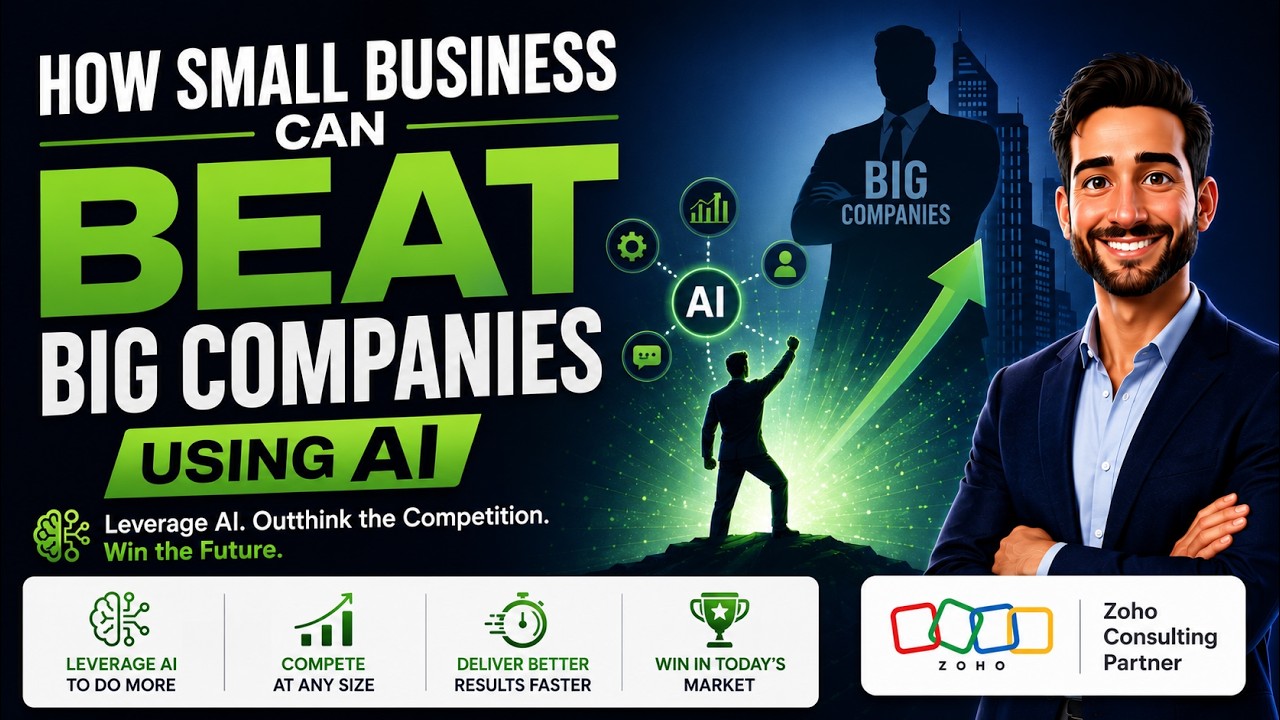
AI for small business: how small business can beat big companies using AI.

Large companies may have more people, money and market power. Small businesses compete through speed, focus and agility.

AI3 min watchPerspective

In this video.

Smaller companies compete on speed, focus and agility. The advantage comes from applying AI to measurable bottlenecks inside real workflows, not from using it everywhere.

What this covers.

  • Respond faster with lower overhead
  • Better customer context, better decisions
  • The advantage is targeted AI, not AI everywhere
Read the full video transcript.

Big companies have more people, money, and market power. Small businesses have speed and focus. This video explains how Zoho, practical AI, and CodeStringers can turn that agility into a meaningful competitive advantage. Large organizations often have layers, legacy systems, approval queues, data silos, and too many handoffs. A simple customer request can move through several departments before anyone is allowed to act. A connected small business can capture a request, understand the context, route the work, prepare the response, and act while a larger competitor is still coordinating internally.

The goal is not to be bigger. It is to be faster and smarter. Use AI for lead qualification, sales follow-up, service triage, forecasting, document work, and operational coordination. The best use cases improve work that already happens every day and produce a result the business can measure. Zoho connects CRM, finance, service, projects, inventory, documents, analytics, and automation. CodeStringers designs the workflows, integrations, data structure, dashboards, and custom capabilities that turn the platform into one operating system. AI cannot overcome duplicate records, missing information, inconsistent definitions, or disconnected systems.

Clean the data, establish one source of truth, secure access, and define human review before trusting the recommendations. Start with one measurable bottleneck. Connect the information, automate the coordination, add intelligence and alerts, and compare the result with the original process. Expand only after the first use case proves its value. Dashboards reveal what changed. Automation routes the work. AI identifies risks and recommends next actions. Employees spend less time searching and chasing status, while leadership sees problems earlier. The result is faster response, lower overhead, better customer context, stronger decisions, and more scalable growth.

AI does not make the small company larger. It helps the small company behave more intelligently. You do not need more bureaucracy. You need connected systems, cleaner data, and smarter workflows. Schedule a complimentary AI and Digital Enablement Assessment and let CodeStringers turn Zoho into an intelligent operating system for your business. One Partner. Better Outcomes.

Questions people ask.

How can a small business compete with a large company using AI?

On speed and focus. Large organisations carry layers, legacy systems, approval queues and data silos, so a simple customer request moves through several departments before anyone can act. A connected small business can capture the request, understand the context, route the work, prepare the response and act while the larger competitor is still coordinating internally. AI does not make the small company bigger. It helps it behave more intelligently.

Where should a small business start with AI?

With one measurable bottleneck inside a workflow that already happens every day: lead qualification, sales follow-up, service triage, forecasting, document work or operational coordination. Connect the information, automate the coordination, add intelligence and alerts, and compare the result with the original process. Expand only after the first use case proves its value. The advantage comes from targeted AI, not from using it everywhere.

What stops AI for small business from working?

The data underneath it. AI cannot overcome duplicate records, missing information, inconsistent definitions or disconnected systems; it reads what it is given and answers confidently. Before trusting any recommendation, clean the data, establish one source of truth, secure access so the AI sees only what the person running it may see, and define where a human reviews the output. None of that is AI work, and all of it decides whether the AI pays off.

What does AI actually change day to day in a small business?

Dashboards reveal what changed, automation routes the work, and AI identifies risks and recommends next actions. Employees spend less time searching for information and chasing status, and leadership sees problems earlier. The result is faster response, lower overhead, better customer context, stronger decisions and growth that does not require adding bureaucracy. The business needs connected systems, cleaner data and smarter workflows rather than more layers.

Integrated business solutions

One partner. Better outcomes.

We design, build, integrate and operate AI-driven, platform-agnostic integrated business solutions for operationally complex companies. Start with a conversation; we will tell you if we are a fit.