See it run

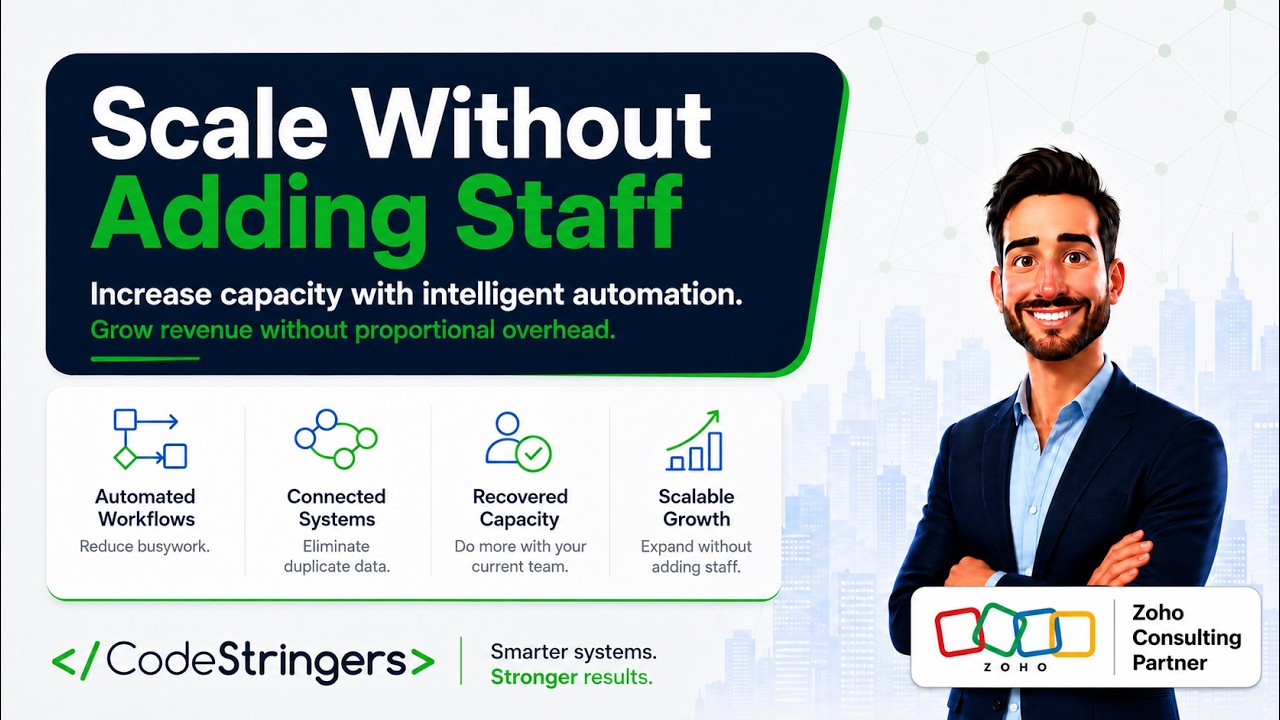
Scale without staffing increases: revenue per employee is the number.

Growth usually means hiring. It does not have to mean hiring proportionally.

Automation3 min watchPerspective

In this video.

How intelligent automation increases capacity and supports more customers without proportionally increasing headcount.

What this covers.

  • Capacity per employee is the number that matters
  • Automate coordination before you automate work
  • Profitability moves before revenue does
Read the full video transcript.

Growth should increase revenue, not administrative overhead. More customers, more projects, and more complexity should not require more people just to keep up. The right systems create capacity. Capacity drives growth. At first, hiring solves every problem. More customers? Hire another salesperson. More invoices? Hire another accountant. More orders? Hire another coordinator. It works for a while, until costs grow almost as fast as revenue and complexity replaces agility. Most organizations do not have a staffing problem. They have a capacity problem. Employees spend too much time entering duplicate data, updating spreadsheets, routing approvals, sending follow-ups, creating reports, and correcting preventable errors.

Imagine two companies producing the same revenue. One relies on manual work and disconnected systems. The other uses automated workflows, connected information, and real-time visibility. The difference is not fewer people. It is more productive people. If thirty employees save just one hour per day through automation, the business recovers seventy-five hundred productive hours every year. That is nearly three-point-six full-time employees of added capacity, without increasing payroll. Every department feels the friction. Sales updates CRM records instead of selling. Finance re-enters data instead of providing insight. Operations manages spreadsheets instead of improving efficiency.

Customer service searches across systems while customers wait. Now imagine a customer placing an order. The CRM updates automatically. Inventory is allocated. Accounting receives the transaction. Operations gets the work order. The customer receives confirmation, and management dashboards update immediately. Automated businesses are simply faster. They respond sooner, produce quotes faster, process orders more efficiently, resolve service requests more quickly, and scale without proportional increases in administrative headcount. Speed becomes a competitive advantage. " Automation creates revenue capacity, productivity, profitability, better customer experiences, and greater agility. At CodeStringers, we connect systems, automate workflows, and remove the bottlenecks that make growth unnecessarily expensive.

Schedule a complimentary Scalability and Automation Assessment, and discover how much more your existing team could accomplish. One Partner. Better Outcomes.

Questions people ask.

How do you scale a business without hiring more people?

Treat growth as a capacity problem rather than a staffing problem. Most employees lose hours to duplicate entry, spreadsheet updates, routing approvals, follow-ups, report building and correcting preventable errors. Connect the systems so information is entered once, automate the coordination between departments, and give each team real-time visibility. The same people then handle more customers, orders and projects, and headcount grows slower than revenue instead of in step with it.

What is the difference between a staffing problem and a capacity problem?

A staffing problem means the work genuinely needs another person. A capacity problem means the people you have are spending their time moving information instead of creating value. Hiring solves every problem at first: another salesperson, another accountant, another coordinator. It works until costs grow almost as fast as revenue and complexity replaces agility. Two companies with the same revenue can differ not in headcount but in how productive each person is.

How much time can automation save per employee?

The video uses a plain example. If thirty employees each save one hour a day through automation, the business recovers about seventy-five hundred productive hours a year, which is nearly three-point-six full-time employees of capacity without adding payroll. The saving comes from every department: sales updating records instead of selling, finance re-entering data, operations managing spreadsheets, and service searching across systems while a customer waits.

Which processes should you automate first to scale?

Coordination before work. The handoffs between departments are where the hours go: an order that has to be re-keyed into accounting, allocated in inventory and scheduled in operations by three people. When a customer places an order, the CRM updates, inventory is allocated, accounting receives the transaction, operations gets the work order, the customer gets a confirmation and the dashboards refresh. Automate that chain first and profitability moves before revenue does.

Integrated business solutions

One partner. Better outcomes.

We design, build, integrate and operate AI-driven, platform-agnostic integrated business solutions for operationally complex companies. Start with a conversation; we will tell you if we are a fit.