CRM for Professional Services: From Pipeline to Paid, in One System
Updated: 20 hours ago
A 20-person agency we worked with could tell you their pipeline and their bank balance, but not the number that actually runs the business: which projects were making money. Sales lived in a CRM, projects in spreadsheets, time in a separate tracker, and invoices in accounting — four systems that never agreed, so margin and utilization were a monthly guess assembled by hand. That disconnect is the defining operational problem of a professional services firm, and it's exactly what an operationally complex business setup on Zoho is built to solve.
Zoho for professional services firms means running the whole pipeline-to-cash cycle — sales, project delivery, time and resourcing, and billing — on connected Zoho apps instead of four disconnected tools. For an agency or consultancy, the payoff is real-time visibility into utilization and project margin because the deal, the project, the hours, and the invoice finally share a single source of truth.
What does a professional services firm actually need to connect?
Every project-based business runs the same loop, and it only works if the stages talk to each other:
Sell — the pipeline: leads, proposals, won deals, with the scope and rate that were agreed.
Deliver — the project: tasks, milestones, resourcing, and the time people actually spend.
Bill — invoicing against time or milestones, then payment and reconciliation.
Learn — utilization, realization, and project margin, so the next proposal is priced from reality.
When those live in separate tools, the loop breaks at every seam: the won deal is re-keyed into a project, hours are re-keyed into an invoice, and margin is reconstructed in a spreadsheet weeks late. The entire case for Zoho here is closing those seams.
Which Zoho apps run a services firm?
You don't need the whole suite. A connected services operation usually runs on four apps, each owning a stage:
App | Job | What it owns |
Zoho CRM | Sell | Leads, proposals, won deals, client relationships |
Zoho Projects | Deliver | Tasks, milestones, resourcing, time tracking |
Zoho Books | Bill | Invoices (time/milestone), payments, reconciliation |
Zoho Analytics | Learn | Utilization, margin, and realization dashboards |
The point isn't the app count — it's that a won deal in Zoho CRM becomes a project in Projects, the hours logged there flow to an invoice in Books, and Analytics reads all three to show margin without anyone rebuilding a spreadsheet. That connected flow is what a pile of best-of-breed tools can't do without constant manual glue.
What the connected flow looks like
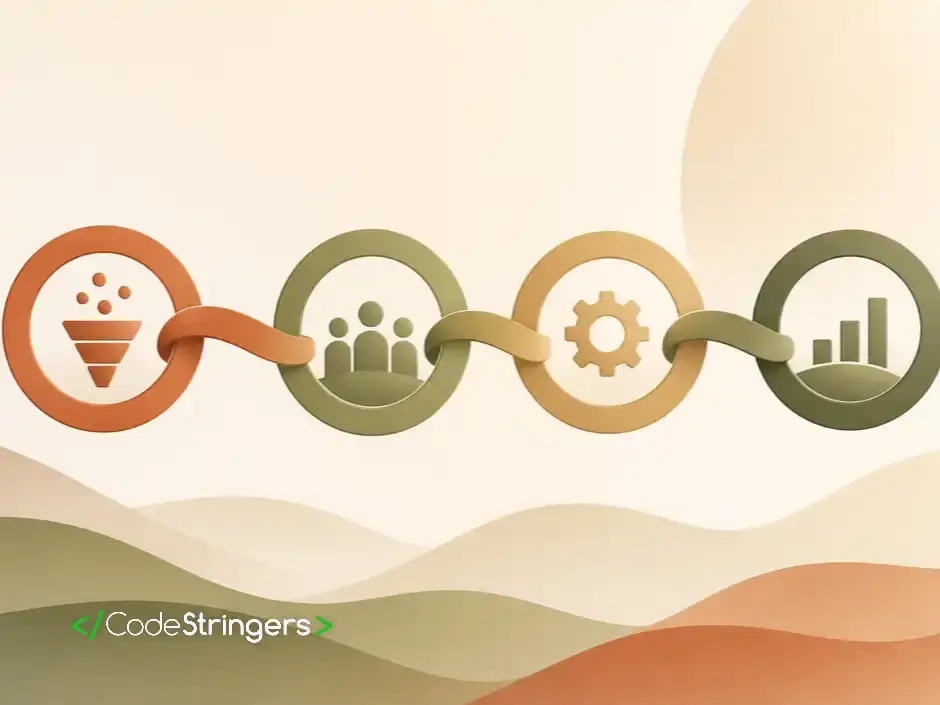
The shape is a chain: CRM (won deal + agreed scope) → Projects (delivery + time) → Books (billing) → Analytics (margin and utilization), with the client record shared across all of it. The win isn't any single app — it's that the number every services firm chases, real-time project profitability, finally falls out of the system instead of being assembled by hand.
A services firm doesn't fail for lack of pipeline. It fails by delivering profitable-looking projects that quietly lose money — and never seeing it until the quarter closes. Connected systems make that visible while you can still act on it.
A worked example: from won deal to margin
For the 20-person agency, the rollout followed the loop:
Won deal carries scope. Closing a deal in CRM created the project shell in Projects with the agreed scope and rate attached — no re-keying.
Time logged against tasks. Delivery happened in Projects, where the team logged hours against tasks, so "what we sold" and "what we're spending" sat side by side.
Invoices from real hours. Books billed against logged time and milestones, so invoicing stopped being a month-end archaeology project.
Margin in a dashboard. Analytics blended all three into a live view of utilization and per-project margin.
The result wasn't a new app to learn so much as a number they'd never reliably had: which clients and project types actually made money. The agency dropped two service lines that looked busy and lost money — a decision they couldn't have made from four disconnected tools. CRM done right returns about $8.71 for every dollar spent (Nucleus Research); for a services firm, the bigger return is the margin you stop leaking.
What it costs, roughly
There's no single number, but the shape is predictable. Licensing for CRM + Projects + Books + Analytics is modest per user — often cheaper than the standalone tools they replace, and the average company already runs over 100 SaaS apps (BetterCloud), so consolidation usually removes cost. Zoho One can bundle it all if you'll use enough apps. The real investment is the implementation — connecting the four stages, mapping your delivery process, and building the margin dashboard — which is where a thoughtful build turns four apps into one system. We scope that per firm, because a 10-person consultancy and a 100-person agency are different projects.
Book a free Zoho consultation if you can see your pipeline and your bank balance but not your project margin: start a no-risk discovery.
Where it fits — and where it doesn't
Zoho fits a professional services firm that wants its sales, delivery, and billing in one connected system at a sensible cost, and is willing to invest in setup. It's less of a fit if you need a deep, industry-specific PSA platform with very specialized resource-optimization or a tool your team already runs well and only needs to connect — in which case integration, not replacement, may be the move. And it returns its value only when adopted: a connected system nobody logs time in is just a more expensive set of disconnected tools. For most agencies and consultancies, though, the pipeline-to-cash chain on Zoho is a strong, affordable fit. The same caution we raise about AI in professional services applies here: the tooling helps only if the operating discipline is there.
The bottom line
For a professional services firm, Zoho's value is connecting pipeline to cash: CRM, Projects, Books, and Analytics working as one system so utilization and project margin are visible in real time, not reconstructed quarterly. It fits agencies and consultancies that want that connected view affordably and will invest in setup and adoption. If you can see everything except whether your projects make money, book a free Zoho consultation and we'll scope the pipeline-to-cash build with you.
By the CodeStringers Team — Zoho Experts & Custom Software. CodeStringers is a custom software engineering firm with a dedicated Zoho practice, writing from work we've actually shipped for clients.
Find out what one connected Zoho system would change in the way you run.
In a no-risk discovery we look at your CRM, finance and operations systems and who owns each part, and show what a connected system would do differently. You pay only if you proceed. Or see how we approach it.
More on the same problem:


Comments